| NO. | Brand | Compatible P/N | Transceiver Type |
| 1 | NVIDIA/Mellanox | MFM1T02A-T | |
| 2 | Netgear | AXM765 | |
| 3 | D-Link | DEM-436XT-B1 | |
| 4 | Ciena | XCVR-A10Y31 | |
| 5 | Fortinet | FN-TRAN-SFP+GC | |
| 6 | Ubiquiti | UF-RJ45-10G | |
| 7 | Dell | GP-10GSFP-T | |
| 8 | Extreme Networks | 10338 | |
| 9 | IBM | 45W2410 | |
| 10 | HPE Aruba | JL563A R9F85A | |
| 11 | Avaya Nortel | AA1403043-E6 | |
| 12 | HPE Aruba | R9F85A | |
| 13 | Mikrotik | S+RJ10 |
| NVIDIA/Mellanox Compatible | MFM1T02A-T | Vendor Name | HYTOPTODEVICE |
| Form Factor | SFP+ (Hot-pluggable) | Data Rate | 10 Gbps (1G/2.5G/5G/10G Auto-negotiation) |
| Connector | RJ-45 | Cable Distance | 30m |
| Media | Copper | Cable Type | Cat6a/Cat7 |
| Max. Power Consumption | ≤2.5W | DDM Support | No |
| Protocols | IEEE 802.3an, IEEE 802.3az, SFF-8431 | Operation Temperature | 0 to 70°C (32 to 158°F) |
To ensure optimal performance, broad device compatibility, and extended hardware lifespan, please follow these deployment best practices for your 10GBASE-T SFP+ copper transceiver:
1. Cabling Requirements & Distance Limits
Recommended Cabling: For maximum 10Gbps transmission up to 30 meters, always use high-quality Cat6A or Cat7 Shielded Twisted Pair (STP) cables.
Legacy Cable Limitations: Unshielded Cat6 cables can theoretically support 10G up to 30–55m under ideal lab conditions, but in production environments, they are highly prone to signal degradation. Cat6A STP is strongly recommended.
2. EMI Protection & Crosstalk Mitigation
High-speed 10Gbps copper signals are extremely sensitive to Electromagnetic Interference (EMI) and Alien Crosstalk (AXT).
Use fully grounded STP/FTP cables and shielded RJ45 connectors.
Avoid running network cables parallel to high-voltage power lines, fluorescent lighting, or heavy industrial machinery.
3. Thermal & Power Management
10GBASE-T transceivers consume significantly more power (typically 2.5W) and generate considerably more heat than optical transceivers.
Port Spacing: Avoid populating adjacent SFP+ ports with copper transceivers continuously.
Airflow Optimization: Leave at least one empty port between copper modules (e.g., checkerboard or staggered layout) to facilitate heat dissipation and prevent thermal throttling.
4. Insertion & Hot-Plugging Sequence
While the transceiver is hot-swappable, following the correct sequence prevents electrical surge or signaling glitches:
Insert Module: Plug the transceiver into the SFP+ slot until it clicks, then pull down the bail latch to secure it in place.
Connect Cable: Plug the RJ45 cable into the transceiver.
To disconnect, always remove the RJ45 cable first before releasing the module latch.
5. System Recognition & Auto-Negotiation
Firmware: Ensure your switch or device firmware is updated to support 10GBASE-T copper transceivers.
Negotiation Delay: Allow 5–15 seconds after connection for the network OS (e.g., Juniper Junos, Cisco NX-OS) to auto-negotiate link speed and duplex status.
Manual Override: If the link fails to establish, manually set the port speed to 10G Full-Duplex instead of relying on auto-negotiation.
6. Physical Handling & Care
Always handle the module by its metallic casing or bail latch.
Do not touch the PCB gold fingers to prevent electrostatic discharge (ESD) and contact contamination.
Do not apply excessive force when plugging in or removing the RJ45 connector.
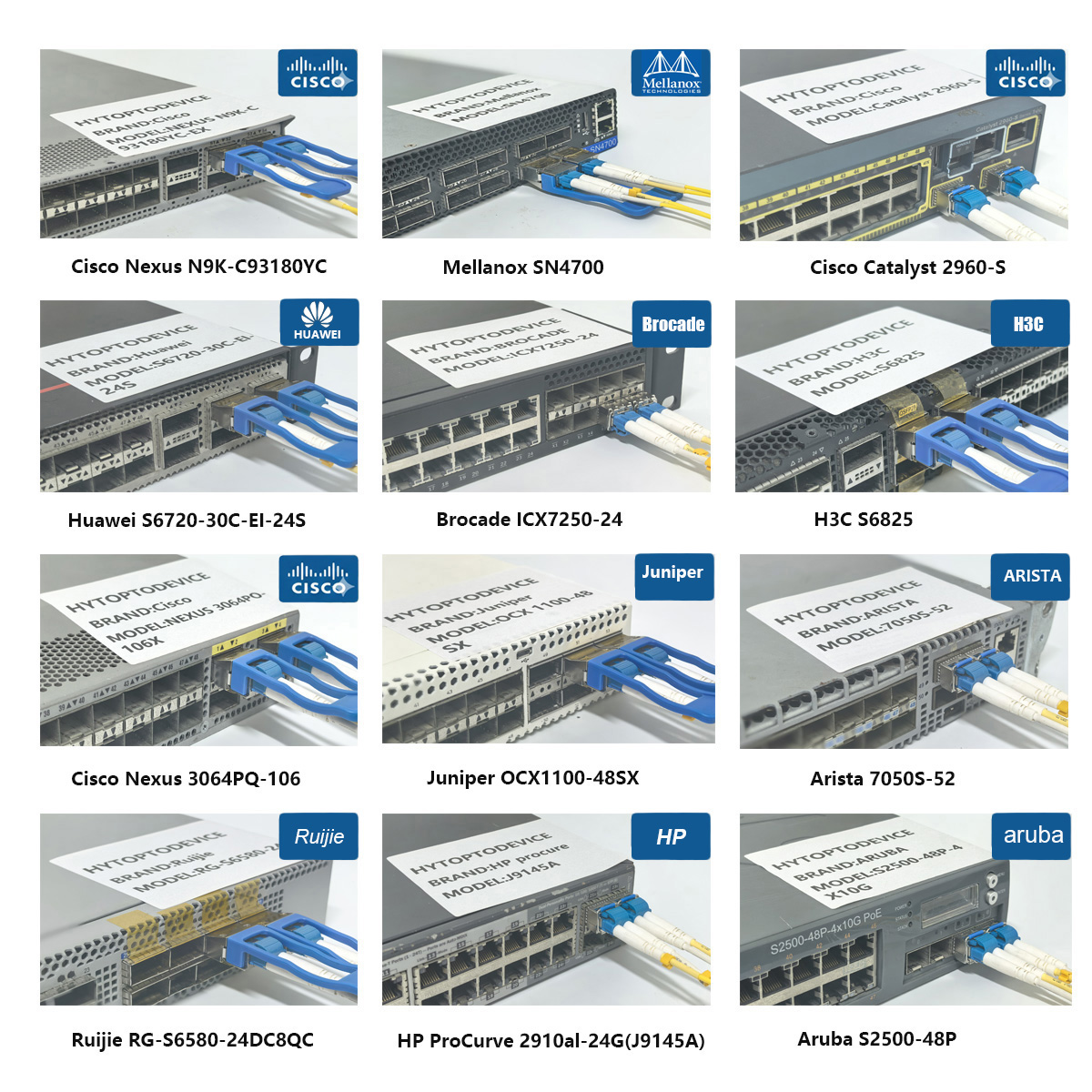
Built on SFP+ MSA and IEEE standards, this 10GBASE-T SFP+ copper transceiver also works with Cisco, Arista, Juniper, Dell and other mainstream network brands, flexible for multi-vendor enterprise LAN network upgrade projects.


The Core Features


FAQ
Q1: Will an SFP-10G-T module work in my switch brand (Cisco, Ubiquiti, MikroTik, HPE, Dell, etc.)?
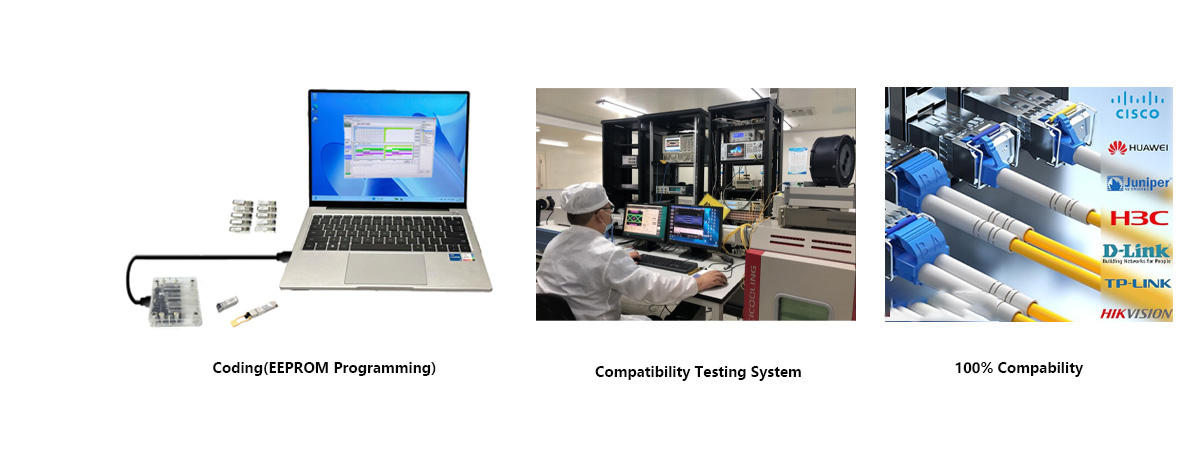
A: Yes, HYTOPTODEVICE 10GBASE-T SFP+ copper transceiver supports multi-brand switch compatibility with custom EEPROM programming. It can run on Cisco, Ubiquiti, MikroTik, HPE, Dell hardware as long as the host has standard SFP+ port and supports 10GBASE-T standard. Pre-sales compatibility verification service is available for bulk buyers.
Q2: Can I use one SFP-10G-T module to connect two different switch brands?
A: Yes, cross-brand switch connection is possible with HYTOPTODEVICE 10GBASE-T SFP+ copper module. The 10GBASE-T standard is MSA-compliant, but auto-negotiation mismatches occasionally occur between different vendors; we recommend pre-testing mixed-vendor links before project deployment for system integrators.
Q3: Can I reprogram an SFP-10G-T module myself?
A: No, end-users cannot safely reprogram EEPROM of this 10GBASE-T SFP+ copper transceiver without professional hardware tools. HYTOPTODEVICE offers free pre-programming service for MFM1T02A-T compatible modules according to buyer’s target host hardware during bulk orders.
Q4: Does SFP-10G-T work in standard 1G SFP ports?
A: No, 10GBASE-T SFP+ copper module cannot plug into 1G SFP ports due to different form factor and pin definition. This HYTOPTODEVICE MFM1T02A-T transceiver only fits SFP+ cages, though it can auto-negotiate down to 1G speed when paired with 1G capable RJ45 devices.
Q5: Are SFP-10G-T modules compatible with network interface cards (NICs)?
A: Yes, HYTOPTODEVICE 10GBASE-T SFP+ copper module works well on NVIDIA/Mellanox ConnectX and other SFP+ based server NICs. It converts the NIC’s SFP+ port into RJ45 copper Ethernet port for server rack short-distance 10G copper connections.
Q6: Why do SFP-10G-T modules get extremely hot during operation?
A: This is normal behavior for 10GBASE-T SFP+ copper transceivers. The integrated 10G copper PHY chip consumes higher power than fiber transceivers and dissipates heat continuously. HYTOPTODEVICE validates every MFM1T02A-T compatible unit under rated operating temperature before shipment.
Q7: Will the high heat damage my switch or adjacent modules?
A: It will not cause permanent damage with proper airflow, but fully populating all SFP+ slots with hot-running 10GBASE-T SFP+ copper modules may trigger thermal alarms. HYTOPTODEVICE advises integrators to evaluate the switch thermal budget before high-density deployment.
Q8: How can I monitor the temperature of my SFP-10G-T module?
A: You can read real-time temperature data via DDM/DOM function built inside HYTOPTODEVICE 10GBASE-T SFP+ copper transceiver. Access CLI or web management on compatible NVIDIA/Mellanox, Cisco or Dell hosts to view module temperature for remote network monitoring.
Q9: Can I run 10Gbps over standard Cat5e cables?
A: No, standard Cat5e cable cannot reliably carry 10Gbps for 10GBASE-T SFP+ copper links. Cat6a or Cat7 cable is required to achieve full 30-meter 10G transmission. Cat5e only supports up to 1Gbps for this HYTOPTODEVICE MFM1T02A-T compatible transceiver.
Q10: Does patch panel density affect 10G copper performance?
A: Yes, high-density patch panels and excessive crosstalk will degrade signal integrity of 10GBASE-T SFP+ copper links. For stable 10G transmission, use shielded Cat6a cabling and properly managed rack wiring when deploying HYTOPTODEVICE 10G copper transceivers.
Q11: How does SFP-10G-T transmission distance compare to fiber optics?
A: Regular 10G copper modules typically support 30m transmission, while selected models can reach up to 80-100m, and HYTOPTODEVICE can deliver maximum reach up to 100 meters. Its reach is far shorter than SFP+ fiber transceivers which can cover multiple kilometers. The 10G copper module is ideal for short intra/ inter rack LAN links, while fiber is the choice for long-distance 10G connections.
Q12: Why does my link only negotiate to 1Gbps instead of 10Gbps?
A: The most common reason is low-grade cabling or poor cable termination for 10GBASE-T SFP+ copper deployment. Cat5e cable, long cable length or bad crimps force auto-negotiation down to 1G. HYTOPTODEVICE recommends Cat6a shielded cable to lock 10G speed for this MFM1T02A-T compatible module.
Q13: Can I lock the port speed manually to 10G in switch settings?
A: Yes, manual port speed locking to 10G is supported on most managed switches for HYTOPTODEVICE 10GBASE-T SFP+ copper transceiver. Manual speed configuration can fix unstable auto-negotiation issues in mixed hardware deployments, but both link ends must match the fixed speed.
Q14: Why are SFP-10G-T modules more expensive than SFP-10G-SR fiber optics?
A: 10GBASE-T SFP+ copper transceivers use complex copper PHY ICs with signal correction circuits, which raises component cost compared to simple optical laser components. HYTOPTODEVICE factory provides competitive bulk pricing for MFM1T02A-T compatible 10G copper modules for wholesale buyers.
Q15: SFP-10G-T vs. 10G Fiber Transceiver: Which is better for long runs?
A: 10G fiber transceiver is the better option for long transmission runs. 10GBASE-T SFP+ copper module from HYTOPTODEVICE only supports up to 30m, while 10G fiber modules can deliver stable 10G links over several kilometers, immune to electrical interference.
Packaging & Custom OEM Solutions
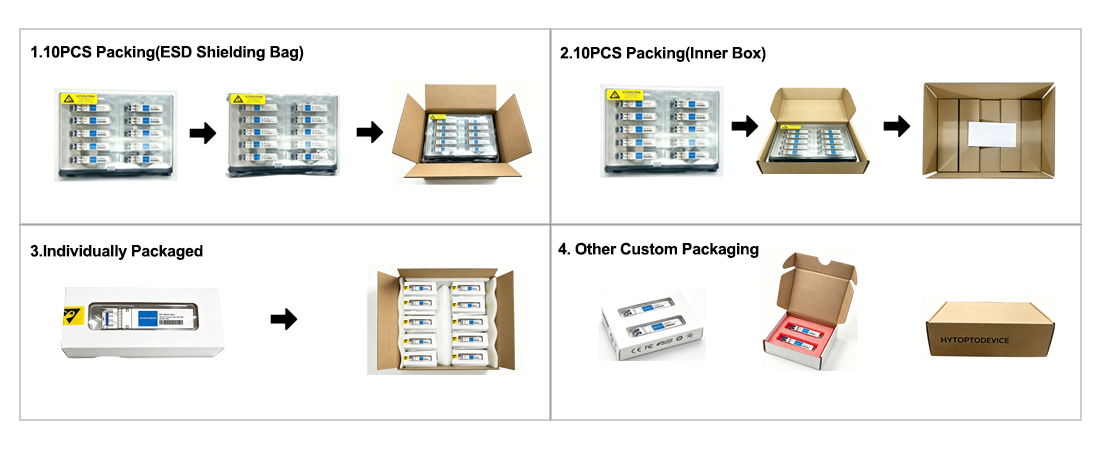
ESD Protection & Fast Shipping: Every module is sealed in an ESD-safe bag and ready for same-day dispatch from stock.
Custom OEM & Branding: We provide logo printing, private labeling, and custom packaging to help distributors and integrators build their brand—no factory investment required.
Why Network Engineers Choose HYTOPTODEVICE
HYTOPTODEVICE has supplied over 5000,000 optical transceiver modules to data centers, ISPs, and enterprise networks across 100+ countries since 2011. Every module undergoes a 72-hour burn-in test and full DDM/DOM validation before shipment.
“Phenomenal performance. We deployed 200 HYTOPTODEVICE SFP modules to replace Cisco OEMs in our backbone network. Result? Zero compatibility issues and a 60% reduction in costs. Highly recommended for mission-critical networks."— Senior Network Engineer, Regional Telecom, Australia
Quality Certification & Compliance
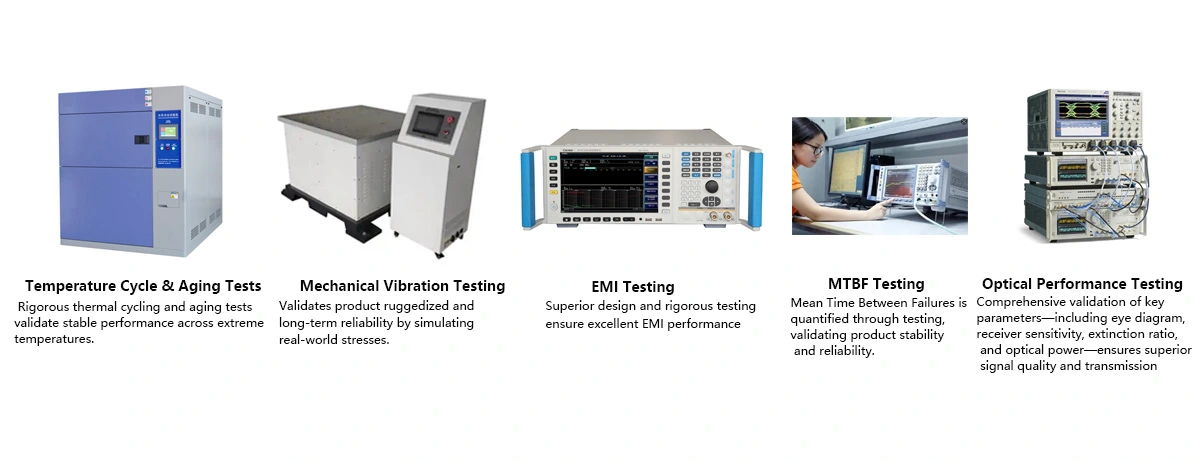
At HYTOPTODEVICE, our quality commitment is backed by industry-standard validations. From fiber optical transceiver manufacturing to final visual inspection, from IQC、IPQC、FQC to OQC, our processes ensure global compliance and reliability.
We adhere to rigorous standards for our SFP modules and network solutions:
ISO 9001: Certified quality management and production consistency.
CE & FCC: Fully compliant for seamless Global Market Access.
RoHS: Committed to environmental responsibility and hazardous material control.
Proven Reliability: Rigorous testing to reduce compliance risk and ensure safety.
Certified Quality. Global Standards. Guaranteed Performance.