Q1: How to resolve CLI displayed failed to recognize and unknown transceiver errors for NVIDIA-compatible QSFP28 100G LR4 Transceiver?
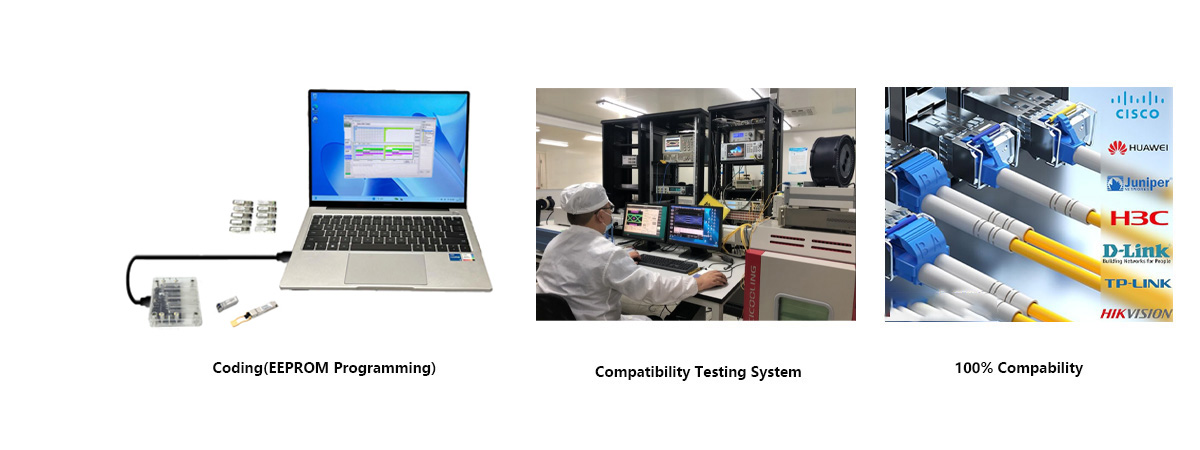
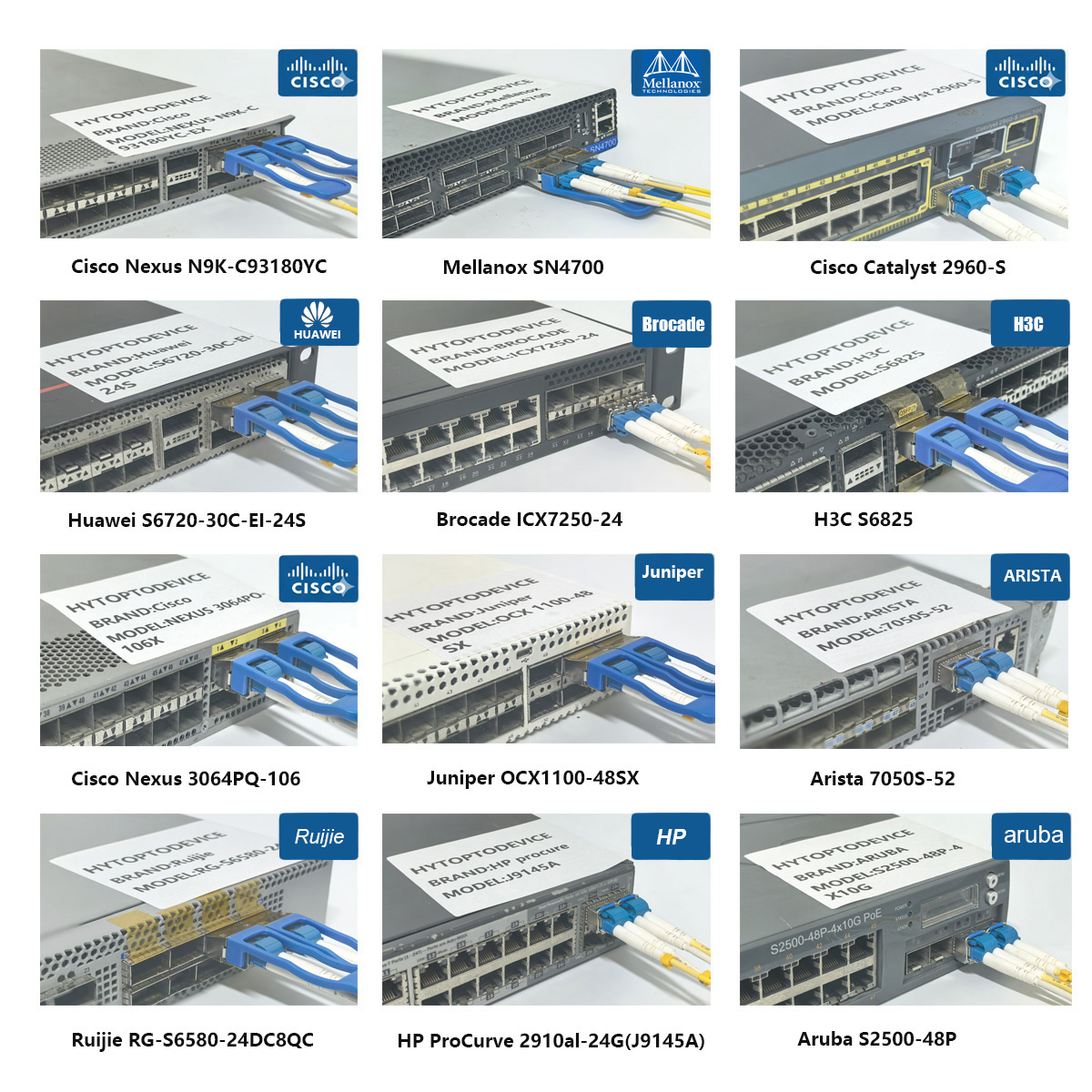
A: Users have two effective solutions to fix unrecognized transceiver faults. You can enable official switch commands such as service unsupported-transceiver for temporary compatibility, or send devices to HYTOPTODEVICE for professional EEPROM firmware re-flashing. Our customized coding perfectly matches NVIDIA system protocols to permanently eliminate transceiver recognition failure alarms.
Q2: Are optical attenuators mandatory for 1km and 2km short-distance single-mode links using standard QSFP28 100G LR4 Transceiver?
A: It depends on the module’s maximum Rx power (Pin max) threshold. If the transmit power of HYTOPTODEVICE factory-calibrated QSFP28 100G LR4 Transceiver exceeds the receiving threshold in 1–2km short fiber spans, you must deploy a 3dB or 5dB fixed optical attenuator to avoid receiver saturation and protect NVIDIA switch port hardware.
Q3: Why do long-reach EML-based QSFP28 100G LR4 Transceiver run hotter than short-range SR4 and CWDM4 optical modules?
A: Short-range SR4 and CWDM4 modules adopt low-power optical structures for near-distance transmission. HYTOPTODEVICE QSFP28 100G LR4 Transceiver is equipped with high-performance EML lasers and integrated internal MUX/DEMUX components, which require higher driving power to stabilize 10km long-haul optical signal transmission, resulting in normal and safe higher operating temperatures.
Q4: What causes high Pre-FEC BER values on clean fiber links with calibrated QSFP28 100G LR4 Transceiver?
A: Even on flawless, clean fiber lines, high Pre-FEC Bit Error Rates are mainly triggered by LAN-WDM chromatic dispersion or gradual degradation of the module’s internal laser transmitter. HYTOPTODEVICE QSFP28 100G LR4 Transceiver adopts premium laser chips with strict factory calibration, effectively reducing BER anomalies and ensuring stable NVIDIA link transmission.
Q5: What are the standard Tx and Rx power operating ranges of industrial-grade QSFP28 100G LR4 Transceiver?
A: HYTOPTODEVICE QSFP28 100G LR4 Transceiver follows industry standard power parameters: the normal transmit (Tx) power range is -4.3 dBm to +4.5 dBm, and the receive (Rx) power maintains a stable range of -10.6 dBm to +4.5 dBm, fully meeting NVIDIA data center long-haul transmission power requirements.
Q6: Is physical breakout available to split 100G bandwidth of standard QSFP28 100G LR4 Transceiver into four independent 25G LR links?
A: Physical breakout is completely unavailable. HYTOPTODEVICE QSFP28 100G LR4 Transceiver integrates professional wavelength multiplexing technology, which multiplexes four independent optical wavelengths into a single duplex LC fiber port internally, making hardware-level 100G-to-25G breakout impossible for NVIDIA network deployment.
Q7: What is the hot-plug mating cycle lifespan of gold fingers on high-quality QSFP28 100G LR4 Transceiver?
A: HYTOPTODEVICE QSFP28 100G LR4 Transceiver adopts thickened gold-plated gold fingers that pass strict industrial durability testing. The module supports a minimum of 100 standard hot-plug mating cycles without electrical contact attenuation or structural wear, adapting to frequent NVIDIA equipment maintenance and plugging operations.
Q8: What laser chip configuration is adopted by 10km long-reach QSFP28 100G LR4 Transceiver for NVIDIA networks?
A: To guarantee ultra-stable long-distance signal integrity for 10km transmission scenarios, all HYTOPTODEVICE QSFP28 100G LR4 Transceiver are equipped with high-quality EML electro-absorption modulated lasers. We completely abandon inferior low-cost DML lasers to avoid signal attenuation and error codes on NVIDIA long-haul links.
Q9: Why do mainstream QSFP28 100G LR4 Transceiver face long lead times during global supply chain disruptions?
A: Professional 100G LR4 optical modules rely on high-precision specialized InP indium phosphide laser chips, which suffer from severe foundry capacity backlogs and shortages during supply chain fluctuations. As a professional supplier, HYTOPTODEVICE maintains sufficient core chip inventory to ensure fast and stable delivery of NVIDIA-compatible QSFP28 100G LR4 Transceiver.
Q10: Does certified QSFP28 100G LR4 Transceiver support Rx_LOS signal propagation when switch port Tx power fails?
A: Fully supported. When the Tx power of NVIDIA switch ports is cut off or fiber links are disconnected, HYTOPTODEVICE QSFP28 100G LR4 Transceiver will instantly output effective Rx_LOS hardware pin signals, actively feeding back link failure status to the host switch for real-time network fault monitoring.
Q11: How to query A0h/A2h internal memory map to verify firmware version of NVIDIA-adaptive QSFP28 100G LR4 Transceiver?
A: Compliant with standard I2C serial interface protocols, HYTOPTODEVICE QSFP28 100G LR4 Transceiver allows users to read the module’s A0h/A2h internal memory map and check complete firmware version and vendor coding information by executing dedicated switch diagnostic CLI commands: show system internal transceiver nvram.
Q12: What causes EEPROM checksum error alarms on NVIDIA switches for generic QSFP28 100G LR4 Transceiver?
A: This error is triggered by corrupted EEPROM data, caused by unqualified factory writing processes or instantaneous electrical spikes on switch ports. HYTOPTODEVICE QSFP28 100G LR4 Transceiver adopts dual verification factory programming and anti-static protection design, completely avoiding EEPROM checksum error faults on NVIDIA devices.
Q13: Can purchased 100G LR4 QSFP28 transceiver operate for both 100GbE Ethernet and EDR InfiniBand workloads
A: Yes. This 100G LR4 QSFP28 transceiver supports dual-protocol operation. It works seamlessly in unified fabric environments mixing Ethernet and EDR InfiniBand traffic for distributed HPC clusters.
Q14: What modulation scheme does the MMA1L10-CR compatible 100G LR4 QSFP28 transceiver adopt
A: This transceiver uses 4×25G NRZ modulation with LAN-WDM wavelengths. It delivers stable 100G aggregate bandwidth for medium-long reach single-mode networking.
Q15: Should procurement teams choose LR4 single-mode or SR4 multimode QSFP28 transceivers for new HPC cluster deployment
A: Select LR4 single-mode for cross-rack and inter-building links beyond 100m. For intra-rack short connections within 100 meters, buyers can select SR4 multimode variants instead of purchased 100G LR4 QSFP28 transceiver.