


| NO. | Brand | Compatible P/N | Transceiver Type |
| 1 | Cisco | QSFP-40G-SR4-S | |
| 2 | APRESIA | H-SR4-QSFP+ | |
| 3 | Alcatel-Lucent | QSFP-40G-SR | |
| 4 | Arista Networks | QSFP-40G-SR4 | |
| 5 | Brocade | 40G-QSFP-SR4-INT | |
| 6 | Check Point | CPAC-TR-40SR-SSM160-QSFP | |
| 7 | Cisco Meraki | MA-QSFP-40G-SR4 | |
| 8 | D-Link | DEM-QX01Q-SR4 |
| APRESIA Compatible | H‑SR4‑QSFP+ | Vendor Name | HYTOPTODEVICE |
| Form Factor | QSFP+ | Max Data Rate | 41.25Gbps |
| Wavelength | 850nm | Max Distance | 150m@OM4/100m@OM3 |
| Connector | MTP/MPO | Transmitter Type | VCSEL 850nm |
| Cable Type | MMF | Receiver Type | PIN |
| TX Power | -8.0~1.0dBm | Receiver Sensitivity | < -13dBm |
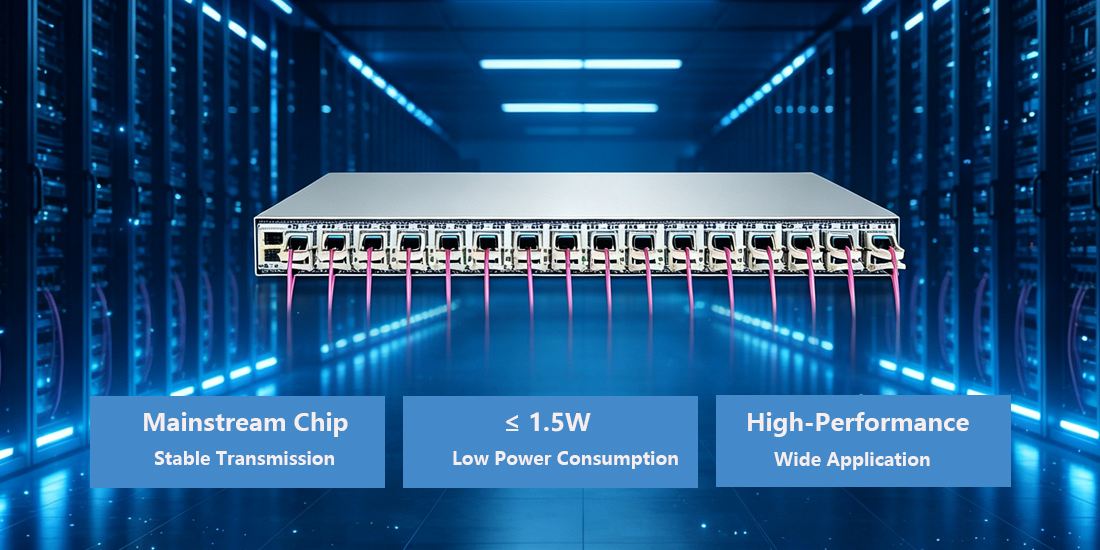
| Power Consumption | ≤1.5W | Modulation | NRZ |
| Protocols | IEEE 802.3 40GBASE-SR4, SFF-8436 | Operation Temperature | 0 to 70°C (32 to 158°F) |
Usage Guidelines & Best Practices
Fiber Choice: Only works with OM3 / OM4 multi‑mode MPO‑12 trunk cable; single‑mode fiber cannot support 850nm SR4 transmission and will lead to link failure.
Distance Limit: Max 100m on OM3 MMF, max 150m on OM4 MMF; excessive splices, dirty end‑faces or sharp bends reduce actual working distance.
Cleanliness & Dust: Keep dust caps on whenever unattached. Clean fiber end-faces with a optical cleaning pen before insertion; dust causes over 80% of optical link failures.
Installation Specification: Hot‑plug supported; keep MPO connector end‑faces clean, observe minimum fiber‑bend radius requirements.
Operating Environment: Commercial temperature range 0°C‑70°C; maintain cabinet airflow to avoid module overheating.
Full Compatibility List and Supported Devices
1. Supported Hardware & Firmware
Primary Application Scenarios
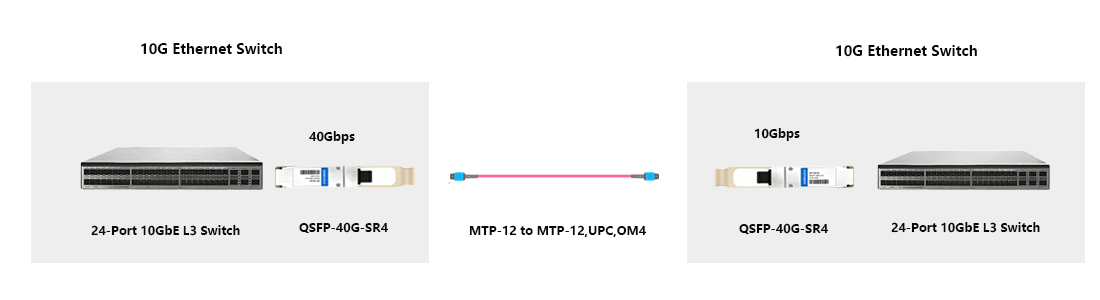
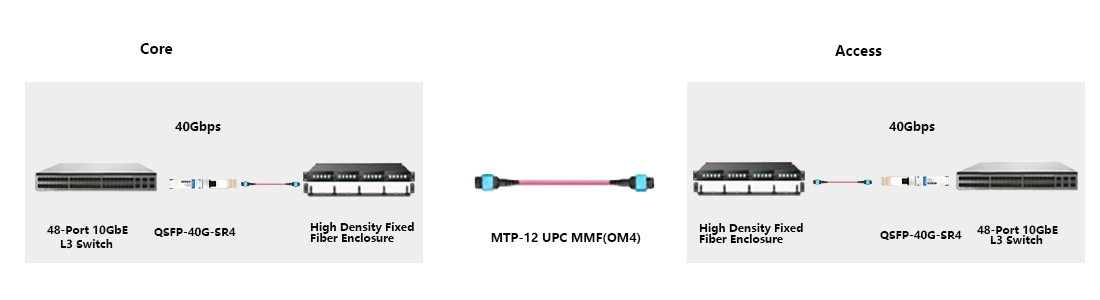
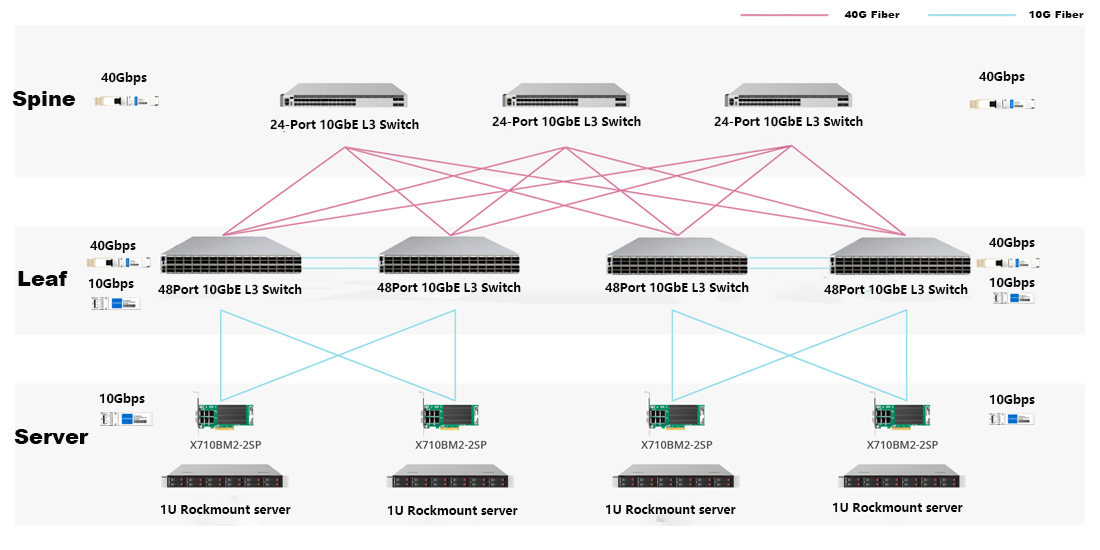
• Short‑reach leaf‑spine inter‑switch connections inside Apresia‑based data‑center architectures
• 40G high‑speed switch stacking and aggregation trunk link expansion for enterprise networks
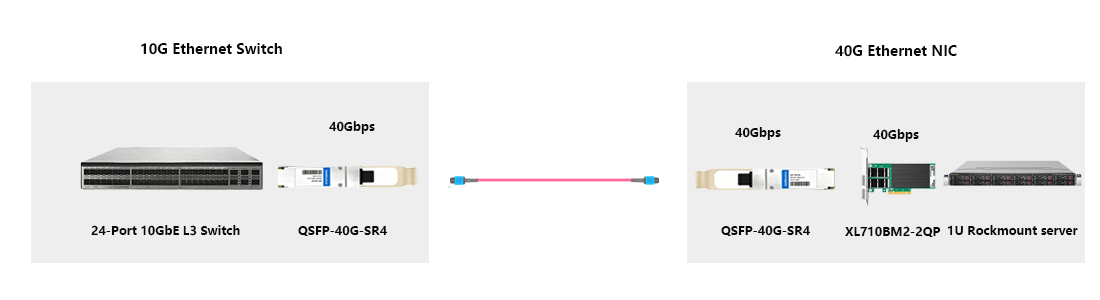
• 40G ToR switch uplinks for virtualization server clusters
• Rack‑to‑rack short‑distance 40G multi‑mode fiber transmission
• Enterprise and ISP data‑center renovation & infrastructure upgrade projects
• Multi‑vendor hybrid network deployment for cloud computing infrastructure


FAQ
Q1: What fiber cable type should I use for APRESIA H‑SR4‑QSFP+ compatible 40G SR4 QSFP+ transceiver? A1: This 40GBASE‑SR4 module requires OM3 or OM4 multi‑mode MPO‑12 trunk cable. OM3 supports up to 100‑meter transmission, OM4 reaches maximum 150‑meter reach. Single‑mode fiber is incompatible and cannot bring up valid 40G links. HYTOPTODEVICE as transceiver manufacturer suggests checking existing cabling specification before bulk purchase.
Q2: Can this 40G QSFP+ SR4 transceiver work normally on APRESIA NP / 15000 series switches? A2: Yes, this HYTOPTODEVICE compatible 40G QSFP+ SR4 optic fits standard QSFP+ ports of validated APRESIA hardware. Pre‑programmed EEPROM eliminates most third‑party transceiver warning alarms. Buyers need to confirm target host ports support 40GBASE‑SR4 standard before placing wholesale orders.
Q3: Is hot‑swap operation allowed for 40G QSFP+ SR4 transceiver during live‑network running? A3: QSFP+ form factor supports hot‑swap by MSA specification. For critical production networks, it is recommended to shut down corresponding port before plug‑in / plug‑out, to prevent transient signal fluctuation and accidental network interruption.
Q4: Do I need to buy 40G SR4 transceivers in matched pairs for point‑to‑point links? A4: Yes, two identical 40GBASE‑SR4 QSFP+ transceivers must be deployed at opposite ends of one fiber link. SR4 relies on four‑lane parallel optical transmission; mismatched transceiver types will result in link negotiation failure.
Q5: Can I request custom EEPROM programming when sourcing bulk 40G QSFP+ SR4 transceiver? A5: Yes. HYTOPTODEVICE as optical transceiver supplier offers custom EEPROM configuration service for wholesale and bulk procurement. For large‑volume orders, we adjust identifier information to adapt to special host‑device access‑control requirements.
Q6: What are common causes for link‑up failure after installing 40G SR4 QSFP+ module on APRESIA switches? A6: Top failure triggers include contaminated or scratched MPO fiber end‑faces, wrong fiber‑cable category, incorrect port speed‑mode configuration, or EEPROM identification conflict. Wholesale project buyers can obtain technical troubleshooting support from our engineering team.
Q7: Does DDM / DOM diagnostic function take effect when using this compatible 40G SR4 module on APRESIA platforms? A7: Yes, DDM DOM function works properly on supported APRESIA devices. Operators can read real‑time transmit optical power, receive power and module temperature data through CLI or web management interface for daily operation and maintenance.
Q8: Can 40G QSFP+ SR4 module be deployed for extra‑short links under 20 meters inside racks? A8: Short‑distance rack‑internal deployment below 20m is fully supported. No optical attenuator is needed for multi‑mode SR4 application. Please guarantee MPO connector cleanliness and correct pin alignment to avoid signal loss.
Q9: What laser component is adopted inside HYTOPTODEVICE 40G QSFP+ SR4 optical module? A9: It uses mature 850nm VCSEL laser array together with PIN photodiode receiver array. The parallel optical components go through strict factory aging screening, delivering stable performance for long‑term 24/7 continuous running inside data‑center environments.
Q10: What will happen if I run 40G SR4 QSFP+ transceiver beyond rated OM4 150m distance limit? A10: Exceeding 150‑meter OM4 reach will cause insufficient optical power budget, triggering rising bit‑error rate, random packet loss or intermittent link flapping. Even if link lights show online temporarily, it is not suitable for formal production network use.
Q11: Are these wholesale 40G QSFP+ SR4 optical modules compliant with global industry standards for international project procurement? A11: All HYTOPTODEVICE 40G SR4 QSFP+ transceivers comply with QSFP+ MSA, IEEE 802.3bm and RoHS requirements. Standardized mechanical and electrical design guarantees interoperability for multi‑vendor mixed‑vendor network projects, satisfying bidding and procurement demands of global system integrators.
Q12: What cooling suggestions apply when fully populating APRESIA switch QSFP+ slots with bulk‑ordered 40G SR4 modules? A12: Each 40G SR4 module consumes ≤1.5W, thermal load per unit is low. When all slots are populated, maintain normal fan‑speed operation and keep cabinet air‑intake and exhaust vents unblocked. Sustained poor heat dissipation accelerates internal laser component aging and shortens module service life.
Q13: What warranty terms can wholesale buyers obtain for this APRESIA compatible 40G QSFP+ SR4 transceiver? A13: HYTOPTODEVICE provides multi‑year warranty coverage for 40G QSFP+ SR4 modules. Quality‑defective units under normal operating conditions are eligible for replacement. It is a reliable choice for long‑term data‑center and enterprise network procurement.
Q14: Can 40GBASE‑SR4 QSFP+ transceiver interoperate with other 40G optical standards such as 40G‑LR4? A14: Direct interoperation between SR4 and LR4 is impossible. SR4 works on 850nm multi‑mode parallel lanes; LR4 uses single‑mode 1310nm wavelength division multiplexing. The two standards have completely different optical physical layers and cannot establish valid connections.
Q15: Is sample testing available before large‑volume wholesale purchase of 40G QSFP+ SR4 transceiver? A15: Yes, HYTOPTODEVICE supports small‑quantity sample testing for project verification. Customers can verify compatibility and link performance on their actual APRESIA hardware before committing to large‑scale bulk procurement orders.
Packaging & Custom OEM Solutions
Every QSFP+ SR4 module comes individually sealed in standard anti-static (ESD-safe) packaging, pre-stocked and ready for immediate shipment. For bulk orders, we offer custom OEM packaging—including logo printing and private labeling—tailored for network distributors, system integrators, and enterprise deployments.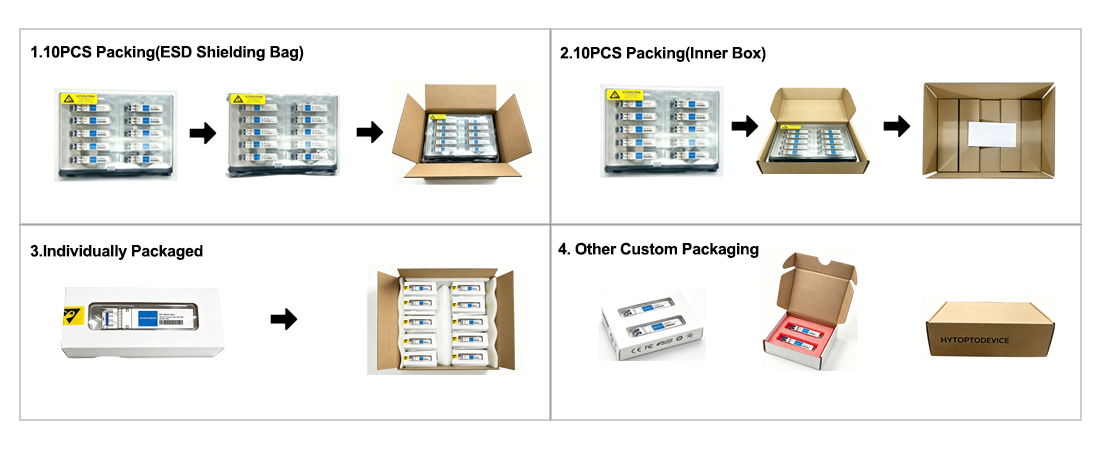
Why Network Engineers Choose HYTOPTODEVICE
HYTOPTODEVICE has supplied over 5000,000 optical transceiver modules to data centers, ISPs, and enterprise networks across 100+ countries since 2011. Every module undergoes a 72-hour burn-in test and full DDM/DOM validation before shipment.
“Phenomenal performance. We deployed 200 HYTOPTODEVICE SFP+ modules to replace Cisco OEMs in our backbone network. Result? Zero compatibility issues and a 60% reduction in costs. Highly recommended for mission-critical networks."— Senior Network Engineer, Regional Telecom, Australia
Quality Certification & Compliance
At HYTOPTODEVICE, our quality commitment is backed by industry-standard validations. From fiber optical transceiver manufacturing to final visual inspection, from IQC、IPQC、FQC to OQC, our processes ensure global compliance and reliability.
We adhere to rigorous standards for our SFP modules and network solutions:
ISO 9001: Certified quality management and production consistency.
CE & FCC: Fully compliant for seamless Global Market Access.
RoHS: Committed to environmental responsibility and hazardous material control.
Proven Reliability: Rigorous testing to reduce compliance risk and ensure safety.
Certified Quality. Global Standards. Guaranteed Performance.






