Q1: How does fiber aging affect the 80km transmission distance of 1590nm 10G CWDM SFP+ Module over time?
A1: As fiber cables age or undergo repeated repairs and splicing, additional signal attenuation will accumulate on the 80km long-span link. For stable long-term operation of 1590nm 80km 10G CWDM SFP+ Module, it is recommended to reserve a 3 dB to 5 dB optical power safety margin during link budget planning, effectively offsetting extra loss caused by fiber aging and ensuring sustained error-free transmission.
Q2: Will chromatic dispersion trigger link issues for 1590nm 10G CWDM SFP+ Module at 80km without dispersion compensation?
A2: At 10G transmission speed over standard G.652 single-mode fiber, chromatic dispersion usually becomes a key limiting factor at 70-80km distances. Our upper-band 1590nm 10G CWDM SFP+ Module adopts high-performance EML laser customized for 80km long-haul scenarios, which can effectively resist conventional dispersion impact and support stable 80km transmission without compensation. However, low-quality, aging fiber lines with excessive dispersion penalty require additional DCM dispersion compensators to guarantee link stability.
Q3: Is 1590nm upper-band 10G CWDM SFP+ Module suitable for long-term CWDM expansion project operation?
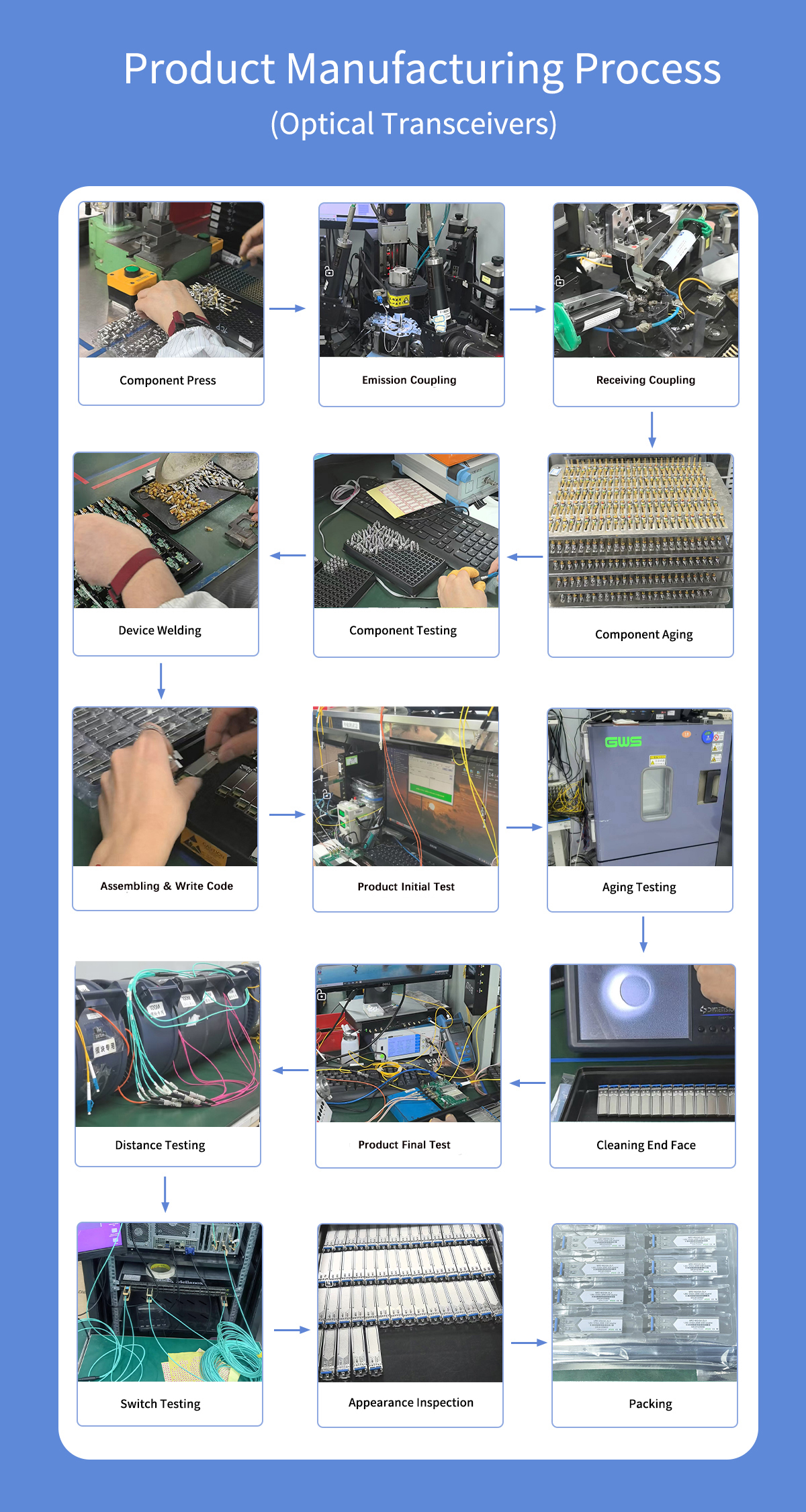
A3: Designed for high-density CWDM expansion scenarios, the 80km upper-band 10G CWDM SFP+ Module adopts high-precision laser and receiver components. Through strict raw material screening and full-load aging testing, it eliminates operating hidden dangers, maintains excellent MTBF performance, and fully meets the long-cycle stable operation requirements of carrier-grade network upgrade projects.
Q4: What standard wavelength options are available for 10G CWDM 80km SFP+ Module networking?
A4: Our 10G CWDM 80km SFP+ Module series covers 8 standard ITU-T CWDM channels ranging from 1470nm to 1610nm, with a fixed 20nm standard channel spacing. The 1590nm upper-band wavelength is one of the core dedicated channels for high-density CWDM expansion, perfectly matching all standard 8-channel CWDM MUX/DEMUX devices for multi-channel multiplexing networking.
Q5: Can 1590nm 80km 10G CWDM SFP+ Module adapt to new network hardware after equipment replacement?
A5: Our multi-compatible 10G CWDM SFP+ Module 1590nm supports flexible EEPROM parameter rewriting and firmware adjustment. Technicians can modify module identification information according to new switch and router models to complete compatibility adaptation, avoiding module waste caused by equipment iteration and replacement.
Q6: How to solve unrecognized module alarms when using 1590nm 10G CWDM SFP+ Module on Cisco devices?
A6: Our Cisco-matched 10G CWDM SFP+ Module 80km 1590nm is pre-calibrated with standard Cisco identification data for native device recognition. For individual old IOS versions, simple configuration commands can shield third-party verification mechanisms, realizing zero-alarm, full-function stable operation.
Q7: What insertion loss penalty will CWDM MUX/DEMUX bring to 1590nm 80km CWDM module links?
A7: A standard 8-channel CWDM MUX/DEMUX device typically introduces 1.5 dB to 3.0 dB insertion loss per port side. This fixed loss must be deducted from the 23 dB total optical power budget of the 1590nm 80km 10G CWDM SFP+ Module during network planning, to avoid insufficient power margin causing link packet loss or disconnection.
Q8: Does the 1590nm 80km 10G CWDM SFP+ Module adopt DFB or EML laser?
A8: This long-haul 1590nm 10G CWDM SFP+ Module is fully equipped with EML (Electro-absorption Modulated Laser) instead of ordinary DFB lasers. DFB lasers produce severe spectral chirp and signal widening under 10G high-speed long-span transmission, triggering serious chromatic dispersion errors. EML lasers effectively suppress chirp distortion, fully meeting the 80km long-distance transmission requirements of upper-band CWDM modules.
Q9: Can the 1590nm CWDM module run seamlessly on Cisco, Juniper and Huawei switches simultaneously?
A9: A single generic firmware cannot support simultaneous compatibility with multi-brand locked devices. Mainstream brands including Cisco, Juniper, and Huawei adopt exclusive vendor-locking authentication algorithms. To achieve stable operation, the EEPROM of 1590nm 80km 10G CWDM SFP+ Module needs targeted coding and parameter calibration according to the specific brand and model of the host switch.
Q10: Is on-site firmware re-flash available for 1590nm CWDM modules if switch brands are replaced?
A10: Yes. Our adaptable 1590nm 80km 10G CWDM SFP+ Module supports on-site re-programming and firmware re-flash service. Users can complete EEPROM parameter modification and brand adaptation with a professional compatible module coding box provided by us, realizing flexible reuse of modules after equipment iteration and replacement.
Q11: What is the maximum power consumption of the 10G 80km 1590nm CWDM SFP+ Module?
A11: The 1590nm long-haul 10G CWDM SFP+ Module has a maximum power consumption ranging from 1.5W to 1.8W, which is significantly higher than ordinary standard 10G LR short-range modules (about 1W). The higher power design ensures sufficient optical power budget and stable signal output for 80km ultra-long transmission scenarios.
Q12: Will full 48-port deployment of 1590nm 80km CWDM modules cause switch overheating?
A12: There is a potential overheating risk in high-density full-port deployment. The 1590nm 80km 10G CWDM SFP+ Module features higher power consumption and heat generation than regular modules. To avoid thermal shutdown and equipment failure, excellent chassis ventilation and systematic airflow management are required for 48-port full-load deployment on switches.
Q13: Can 1590nm CWDM 80km module be directly connected to a regular DWDM module?
A13: Direct interconnection is not supported. CWDM and DWDM systems adopt completely different wavelength channel grids and frequency spacing standards. The 1590nm 10G CWDM SFP+ Module cannot match the signal frequency and channel parameters of DWDM modules, so the two types of modules cannot communicate and interact directly.
Q14: Why are 80km CWDM modules more expensive than standard 10G ZR 1550nm modules?
A14: 80km CWDM modules including our 1590nm 10G CWDM SFP+ Module require strictly wavelength-tuned EML lasers for 8 independent standard CWDM channels. The precise wavelength calibration and high-precision component screening lead to lower manufacturing yields and higher production costs, compared with single-wavelength universal 1550nm 10G ZR modules.
Q15: Does the 1590nm 80km CWDM SFP+ Module support hot-plug operation on live switch ports?
A15: Yes. This 1590nm high-density 10G CWDM SFP+ Module complies with SFP+ MSA industrial hot-swap specifications. It supports safe hot-plug and hot-swap operation on live switch ports, without interrupting the normal operation of other ports and the entire switch system, facilitating on-site installation, replacement and maintenance.