


使用HTML,JS,CSS制作页面模块,让你的网站变得更受欢迎

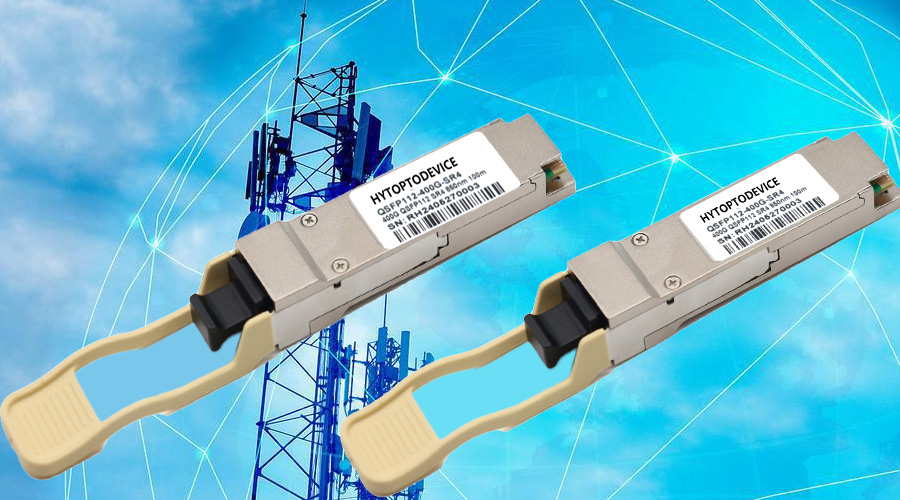
The 100G QSFP28 SR4 is a pluggable transceiver designed for short-range (SR) applications. it uses a 12-fiber MPO/MTP interface and operates over OM3 or OM4 multimode fiber (MMF).
Distance: Up to 70m (OM3) or 100m (OM4).
Architecture: Modular design where the transceiver and fiber patch cords are separate.
Best For: Flexible cabling and high-performance environments like HPC clusters.
The 100G AOC integrates two QSFP28 transceivers with a fixed multimode fiber cable into a single, "all-in-one" assembly.
Distance: Typically available in fixed lengths up to 100m.
Architecture: A sealed, factory-tested link that eliminates the need for separate connectors and cleaning.
Best For: Intra-rack and inter-rack connections where "plug-and-play" simplicity is a priority.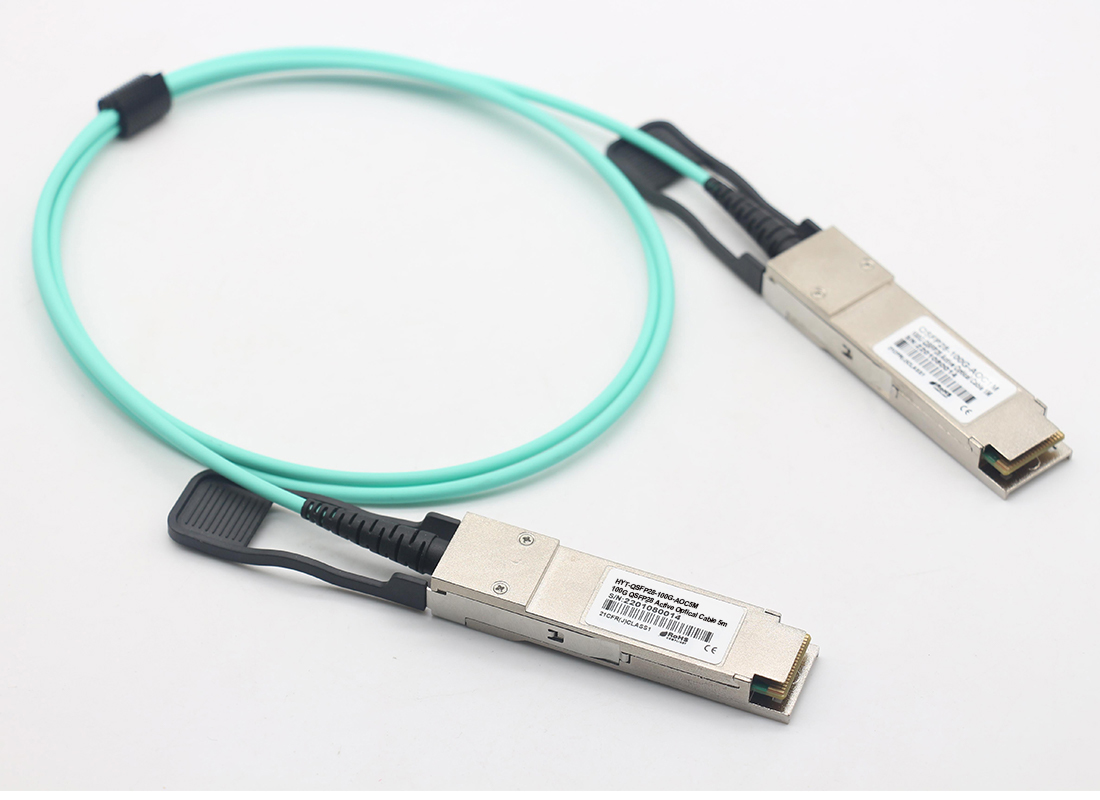
2.Technical Specifications Comparison Between QSFP28 100G SR4 and 100G AOC Cable
| Feature | 100G SR4 Optical Module | 100G QSFP28 AOC |
| Media Type | OM3/OM4 Multimode Fiber | Integrated Multimode Fiber |
| Max Distance | 100m (OM4) | 100m |
| Connector | MPO/MTP-12 | Fixed (Factory Sealed) |
| Flexibility | High (Replaceable cables/modules) | Medium (Fixed length) |
| Power Consumption | Typically ≤ 2.5W | Typically < 2.2W - 3.5W |
| Installation | Requires cleaning/matching | Plug-and-Play |
| Maintenance | Single component replacement | Full link replacement |
Both solutions utilize 4x25Gbps parallel channels to achieve full 100Gbps throughput. At HYTOPTODEVICE, our SR4 modules and AOCs are tested to ensure zero packet loss and full line-rate performance across all compatible switches.
100G SR4: Offers slightly lower latency due to a simpler signal processing chain. This is critical for High-Frequency Trading (HFT), real-time AI analytics, and supercomputing.
100G AOC: Features active driver circuitry that may add picoseconds of latency. While negligible for standard cloud storage, it’s a factor for ultra-low-latency architectures.
AOC Advantage: Because the fiber is factory-sealed, there is no risk of dust contamination on the end-faces during installation. This makes AOCs exceptionally stable for "one-time" deployments.
SR4 Advantage: Supports Digital Diagnostic Monitoring (DDM), allowing engineers to track real-time temperature, voltage, and optical power. With proper cleaning, SR4 provides a highly transparent and manageable link.
Initial Investment: AOCs generally have a lower entry cost for short-range links because you don't need to purchase separate patch cords.
Maintenance & Longevity: SR4 is more cost-effective in the long run. If an SR4 module fails, you only replace the module. If an AOC fails, you must replace the entire cable, which can be labor-intensive if the cable is routed through complex trays.
6. Comprehensive Comparison and Selection Guide
6.1.Choose 100G AOC:When your needs include fixed, high-density, and rapid deployment connections within a server rack or between adjacent racks (≤30 meters), and you prioritize simplified maintenance and the lowest total cost of ownership, AOC is the ideal choice.
6.2.Choose 100G QSFP28 SR4 Optical Modules:When the connection distance exceeds 30 meters, or when network cabling requires flexibility and adjustability, and when there are high requirements for fault location and component reuse, the SR4 optical module solution is more suitable.
6.3.Factory Insight(remind):
Dust Control: Remind users that 80% of SR4 link failures are due to dust on MPO connectors. Since AOCs are factory-sealed, they eliminate this variable entirely.
Bend Radius: Mention that AOCs often use BIF (Bend Insensitive Fiber), making them more resilient in tight cable management arms compared to some bulk MPO jumpers.
Total Cost of Ownership (TCO): While AOC is cheaper today, SR4 allows you to upgrade the cable (e.g., from OM3 to OM4) without replacing the expensive optics, or vice versa.
As a manufacturer with extensive experience in optical communication products, HYTOPTODEVICE has dealt with thousands of domestic and international buyers. The following factors must also be considered:
The "Hidden" Maintenance Factor:While AOCs are easier to install (plug-and-play), remind your readers that if an AOC fails, the entire cable must be re-pulled through the racks. With SR4 modules, you only replace the small transceiver at the end, leaving the expensive MPO trunk cables untouched in the cable trays.
*Signal Integrity (SI):At 100G speeds, signal integrity is sensitive. Because the fiber and the optics are integrated at HYTOPTODEVICE factory, the signal is optimized for that specific length, often leading to a better Bit Error Rate (BER) than a field-assembled SR4 + MPO link.
*Airflow and Density:In high-density 100G switches, heat is a major enemy.
AOC Advantage: Usually thinner and more flexible than standard MPO patch cords, which helps improve airflow at the back of the server.
SR4 Advantage: Standardizes the port layout, which some engineers prefer for long-term "structured cabling" compliance.
100G QSFP28 SR4 Transceiver vs. 100G Active Optical Cable (AOC)
| Feature | 100G QSFP28 SR4 Transceiver + MPO Cable | 100G Active Optical Cable (AOC) | Selection Insights & Best Practices |
| 1. Transmission Distance | Supports longer reaches: up to 70m (OM3), 100m (OM4), or 150m (OM5/eSR4) by selecting different fiber grades. | Fixed short lengths: standard from 1m to 30m. Lengths over 30m are rare and significantly more expensive. |
>30m: Use SR4 Transceivers. <30m: Both are viable; proceed to cost/maintenance comparison. |
| 2. Deployment & Maintenance | Complex: Requires separate procurement of MPO patch cords. Higher risk of end-face contamination during installation. | Plug-and-Play: Factory-terminated. No fiber cleaning required. Zero risk of interface contamination. |
High-Density/ToR: AOC is superior for fast server-to-switch deployment. Structured Cabling: SR4 is better for flexible patching and future-proofing. |
| 3. Flexibility | High: Transceivers and cables can be replaced or tested independently. Easier to troubleshoot specific link segments. | Low: Fixed length. If one end or the cable fails, the entire assembly must be replaced. Cannot be routed through tight conduits easily. | Use SR4 if the environment requires modularity or frequent changes in cable routing. |
| 4. Cost Analysis | Higher Initial CAPEX: Must purchase two transceivers and an MPO cable separately. | Lower Initial CAPEX: Integrated design saves on connector costs and individual housing/testing. | Budget-Constrained: AOC is more cost-effective for large-scale, short-reach interconnects within a rack. |
| 5. Reliability & Troubleshooting | Points of failure exist at the MPO mating interfaces. However, modularity allows for rapid isolation of faulty components. | Higher theoretical reliability due to fewer exposed connection points, but difficult to diagnose if a failure is internal to the cable or the IC. | For High-Aailability clusters where "replace-all" is acceptable for speed, choose AOC. For Granular O&M, choose SR4. |
| 6. Power & Thermal | Higher consumption: typically ≤3.5W per module. Requires robust thermal management in high-density switch ports. | Lower consumption: simplified circuitry (no laser drivers for external fiber) often leads to <2.5W per end. | In ultra-high density or heat-sensitive environments, the lower TDP of AOCs is a critical advantage. |
| 7. Standardization & Compatibility | Follows MSA standards. High interoperability, though vendor-locking (EEPROM) must be verified before deployment. | Follows QSFP28 electrical standards. Generally fewer compatibility issues as it acts as a "factory-tuned" link. | For Extreme Compatibility sensitivity, AOC's "plug-and-play" nature is more seamless. |
As a dedicated source factory with over 15 years of industry leadership, HYTOPTODEVICE (HYTODEVICE TECHNOLOGY) provides more than just hardware; we provide peace of mind.
Rigorous Testing: Every 100G SR4 and AOC undergoes comprehensive "eye diagram" analysis and switch compatibility testing in our production workshop.
Custom Solutions: Need a specific AOC length or a custom-coded SR4 for a niche switch? Our engineers provide tailored solutions for every client.
Direct Factory Support: Cut out the middleman. By working directly with our factory, you get professional technical support and highly competitive pricing for bulk deployments.
Choose 100G SR4 for flexibility, low latency, and long-term scalability.
Choose 100G AOC for rapid deployment, ease of use, and short-range stability.
Ready to optimize your 100G network? Contact the experts at HYTOPTODEVICE today for a professional consultation or a direct factory quote.
Reference Source:
100 Gigabit Ethernet
Fiber-optic cable
