In the world of high-speed fiber optics, small details often make a big difference. When choosing fiber optic transceivers or patch cables, you'll inevitably encounter three terms: PC, UPC, and APC.
Choosing the wrong polishing type can lead to signal degradation or, in the worst case, permanent equipment damage. In this guide, Transceiver Manufacturer China HYTOPTODEVICE will explain the differences between each type in detail, helping you make the best choice for your network.
Table of Contents
1.What are SC/APC, LC/UPC?
2.What are PC, UPC, and APC Connectors?
2.1.What is an APC Connector?
2.2.What is an PC Connector?
2.3.What is an UPC Connector?
3.Technical Comparison of APC,UPC,PC
3.1.Key Differences Between APC, UPC, and PC
3.2.APC vs UPC – The Most Common Comparison
4.How to Select the Right Fiber Connector – HYTOPTODEVICE
4.1How to Select APC,UPC,PC
4.2.Avoid to Make Mistakes
4.3.Summary Table – Which One Should You Choose
5.Conclusion
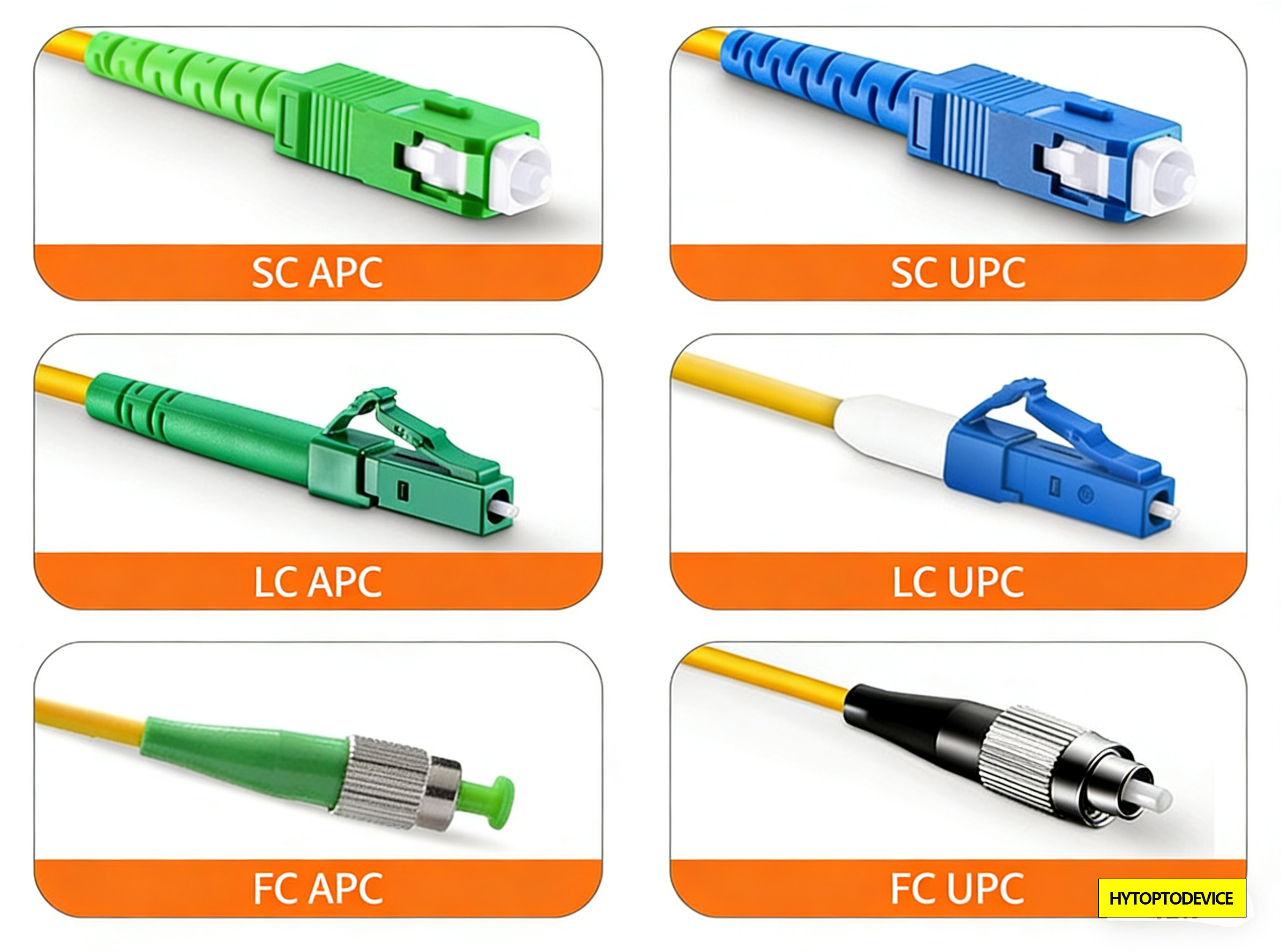
1.What are SC/APC, LC/UPC? You may have come across terms like SC UPC, LC UPC, SC APC, LC APC, FC APC, and FC UPC, but what do they actually mean? LC, SC, and FC represent differences in the structural type of fiber optic connectors, while UPC and APC represent differences in the polishing shape of the connector end face. While they may look similar, choosing the wrong one can increase signal loss, degrade network performance, and cause compatibility issues.
In this next content, we’ll compare APC (Angled Physical Contact), UPC (Ultra Physical Contact), and PC (Physical Contact) fiber connectors, explain their key differences, and help you select the right one for your application. HYTOPTODEVICE your fiber infrastructure from the start.
 2.What are PC, UPC, and APC Connectors?
PC, UPC, and APC indicate how the fiber ferrule (the ceramic tip) inside a connector is polished. This polishing finish determines how much light is reflected back toward the source, a value referred to as Return Loss.
2.1.What is an APC Connector?
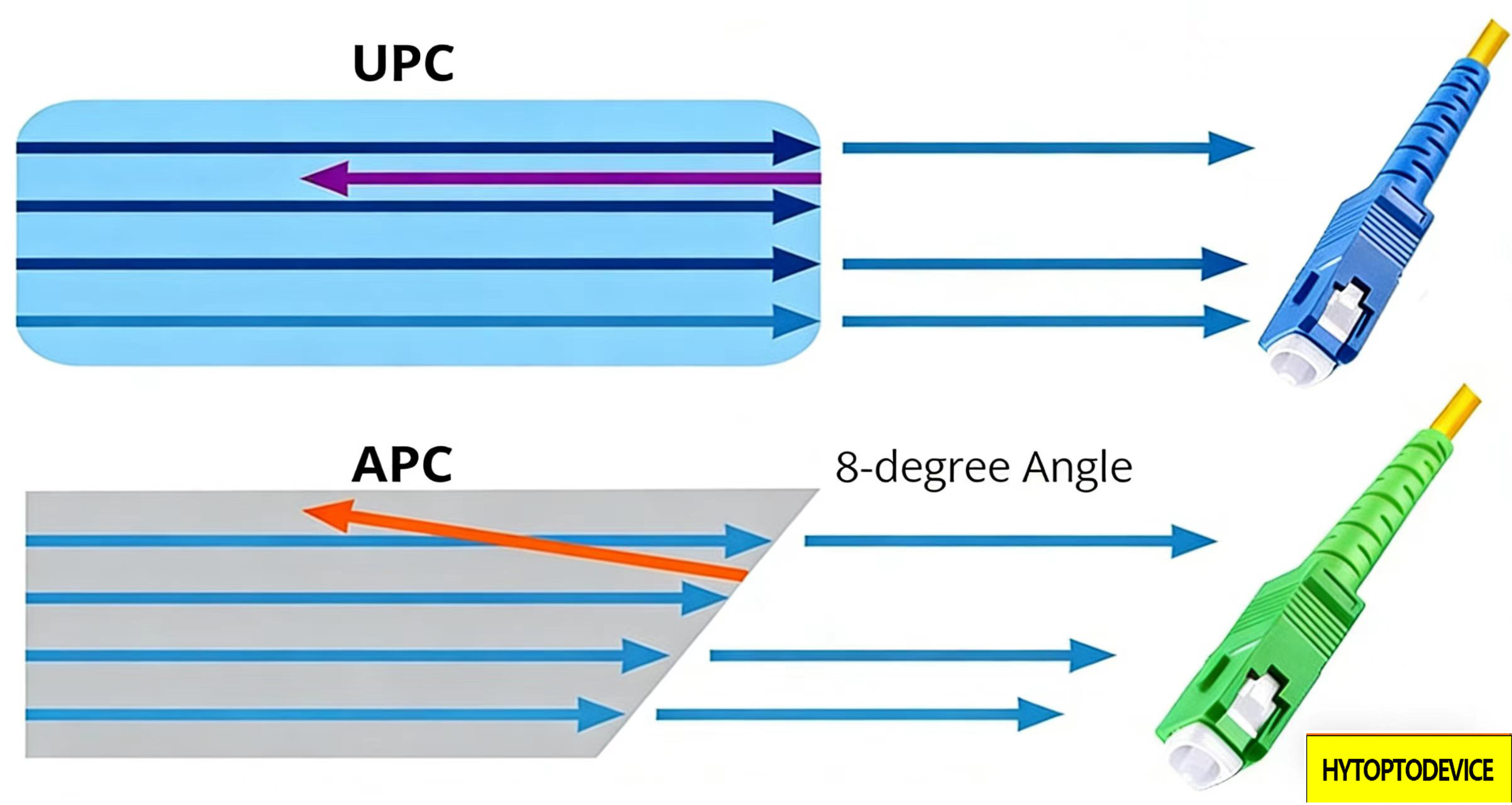
APC (Angled Physical Contact): Features a precision 8-degree angle polish on the ferrule. This angle prevents reflected light from traveling back to the laser source by channeling it into the fiber cladding, resulting in a return loss >60 dB.
APC connector is the most widely used fiber connector type in optical communication. That is because the return loss of the fiber optic APC connector is typically -60dB, which is the smallest among the three types of UPC, APC and PC fiber connectors.Summarized as follows:
-
Features an 8-degree angled end-face.
-
Dramatically reduces back reflection.
-
Return loss: ~60 dB or higher (excellent).

APC Connector Structure
2.2.What is an PC Connector?
PC (Physical Contact):The fiber end face is polished into a slightly convex spherical surface, though it appears flat due to a large radius of curvature. The fiber core sits at the highest point, minimizing the air gap and enabling direct physical contact between two fiber end faces.
The fiber optic PC connector is the oldest one among the three connectors. It minimizes air gaps but has a higher return loss ( >40 dB).Summarized as follows:
-
The original standard for fiber connectors.
-
Uses a slightly curved ferrule end-face for basic physical contact.
-
Return loss: ~40 dB (relatively high reflection).

PC Connector Structure
2.3.What is an UPC Connector?
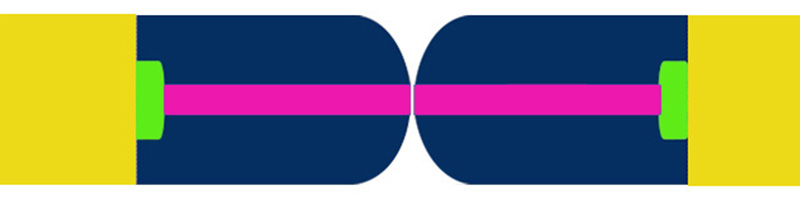
UPC (Ultra Physical Contact) connector is an upgraded version of PC. It retains the convex spherical polish but features a smaller radius of curvature, giving it a more pronounced dome shape compared to the older PC design.
It is an evolution of PC with an extended polishing process,resulting in a better surface finish and lower reflection (>50db ).Summarized as follows:
-
An improved version of PC with a more precise, domed end-face.
-
Lower back reflection than PC.
-
Return loss: ~50 dB or higher.
UPC Connector Structure
3.Technical Comparison of APC,UPC,PC
3.1.Key Differences Between APC, UPC, and PC
| Feature |
PC |
UPC |
APC |
| End-face shape |
Slightly curved |
Domes with higher precision |
8° angle |
| Return loss |
~40 dB |
~50 dB |
≥60 dB |
| Insertion loss |
Moderate |
Low |
Very low |
| Color code |
Beige/Black |
Blue |
Green |
| Sensitivity to dust |
Moderate |
Low |
Very low |
Visual tip: Always check connector color – Blue = UPC, Green = APC.
3.2.APC vs UPC – The Most Common Comparison
APC and UPC are the most commonly used in modern optical communications, such as optical module application. while PC is very traditional and rarely used now.
Like PC connectors, both APC and UPC have distinct end-face structures that determine their performance.
A UPC connector features a flat-convex spherical end-face with no angle. This design provides good physical contact but allows some back reflection.
In contrast, an APC connector has an angled end-face — typically 8 degrees — instead of a flat surface. This 8-degree slope enables more precise contact between two fiber end-faces. More importantly, it significantly reduces back reflection by directing reflected light into the fiber cladding rather than back toward the source.
-
UPC is better for: Digital systems, Ethernet, and short-distance links where cost matters.
-
APC is better for: Analog video, FTTx (GPON), high-speed bidirectional systems, and long-distance DWDM.
4.How to Select the Right Fiber Connector – HYTOPTODEVICE
4.1How to Select APC,UPC,PC
When selecting between PC, UPC, and APC, follow this HYTOPTODEVICE framework:
(1)H – Host application
- Analog/RF? → APC
- Digital/Ethernet? → UPC
(2)Y – Yield loss budget
- Tight loss budget (<0.3 dB)? → APC
- More flexibility? → UPC
(3)T – Transmission direction
- SC Bidirectional (BiDi)? → APC reduces reflections
- Unidirectional? → UPC is fine
(4)O – Original equipment compatibility
- Check transceiver and panel colors. Green means APC, blue means UPC.
(5)P – Performance priority
- Lowest back reflection? → APC (e.g., CATV, high-speed PON)
(6)T – Termination environment
- High vibration? → APC’s angled contact stays more stable
(7)O – Operation & maintenance
- APC resists dust contamination better. High-dust environment? Choose APC.
(8)DEVICE – Device type & network standard
- GPON/XGS-PON → APC
- 10G Ethernet,such sfp-10g-lr → UPC
- Legacy PC → replace with UPC
- High-Speed Ethernet,osfp-800g-sr8→ APC
4.2.Avoid to Make Mistakes
Common Mistakes to Avoid
-
❌ Mixing UPC and APC on a mated pair
-
❌ Using APC for short multimode links – unnecessary cost
-
❌ Ignoring color codes – blue vs green matters
-
❌ Assuming all PC/UPC connectors are identical – UPC outperforms PC
4.3.Summary Table – Which One Should You Choose
| NO. |
Application |
Recommended Connector |
| 1 |
Ethernet (≤10 km) |
UPC |
| 2 |
CATV / Analog video |
APC |
| 3 |
FTTx / GPON |
APC |
| 4 |
Data center (MMF) |
UPC |
| 5 |
High-vibration environment |
APC |
| 6 |
Legacy network upgrade |
UPC (replace PC) |
5.Conclusion
Choosing between APC, UPC, and PC fiber connectors doesn’t have to be difficult.
-
PC – obsolete for most new installs
-
UPC – best for digital, short-range, and cost-sensitive links
-
APC – essential for analog, FTTx, and low-reflection requirements
Remember: Optical Transceiver Manufacturer China HYTOPTODEVICE your selection – from Host application to Device type. This simple framework ensures better performance, lower loss, and fewer compatibility issues.
Need help specifying the right fiber connector for your next project? Contact our team.



