
The jump to 1.6T is not merely a speed upgrade; it is a necessity dictated by three primary factors:
AI Cluster Bottlenecks: Training models with trillions of parameters requires thousands of GPUs. The resulting "East-West" traffic makes 800G a bottleneck. 1.6T is essential to reduce training latency.
Scale Economies in Hyperscale Data Centers: 1.6T doubles bandwidth within the same rack space, offering better energy efficiency and lower Total Cost of Ownership (TCO) per bit.
Technological Continuity: The evolution utilizes existing paths—such as Silicon Photonics (SiPh), EML, and Thin-Film Lithium Niobate (TFLN)—reducing R&D risks for manufacturers like HYTOPTODEVICE.
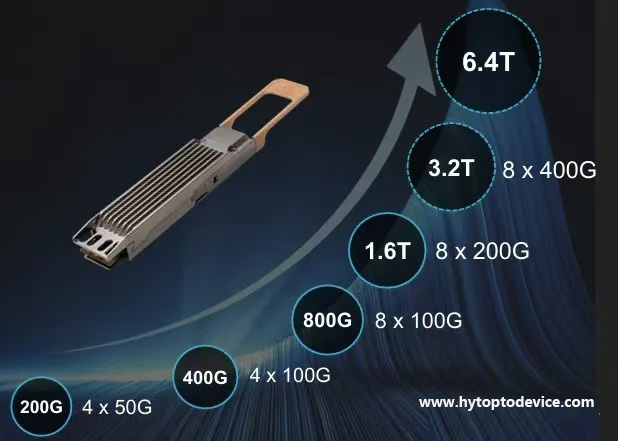
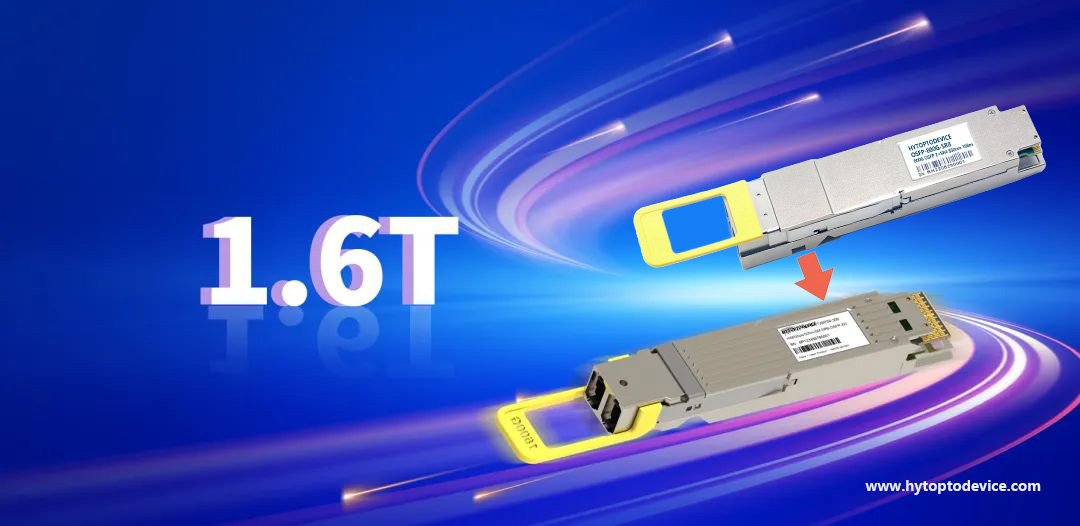
The transition to 1.6T introduces significant hurdles in signal integrity and thermal management.
| Feature | 800G Optical Module | 1.6T Optical Module | Evolution Challenges |
| Technical Realization | Mature 8x100G PAM4 | Emerging 8x200G or 16x100G | Requires 200G/lane technology & 3nm DSPs |
| Form Factor | QSFP-DD / OSFP | OSFP-XD / QSFP-DD1600 | Managing high-density signal integrity |
| Power Consumption | ~15-20W | ~25-35W | Critical focus on pJ/bit efficiency |
| Cost Structure | Cost-optimized, mass scale | High initial premium (2.5x-3x) | Yield rates of 200G chips are the key variable |
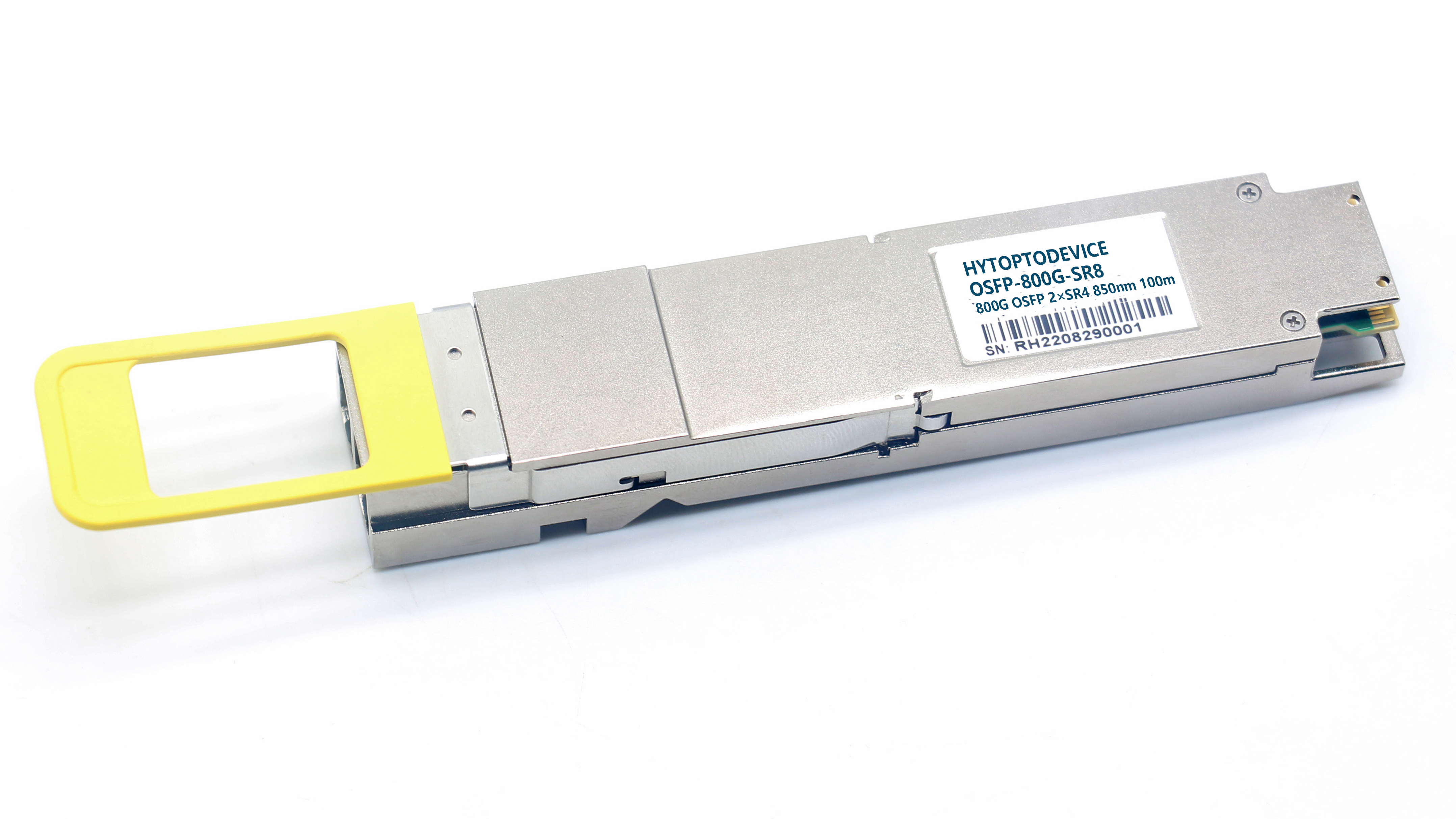
Based on industry trends and technical maturity, HYTOPTODEVICE outlines the following deployment timeline:
This is the year of R&D and interoperability testing. Major players (such as Coherent, Innolight, and Eoptolink) are releasing 1.6T samples for integration with next-generation AI platforms like Nvidia’s Blackwell architecture. HYTOPTODEVICE then began mass production of 800G. OSFP-800G-2SR4
1.6T will see its first deployments in "bandwidth-hungry" environments—specifically Tier-1 cloud service providers' AI training clusters. Performance and supply chain reliability will be prioritized over price.
2026 will be the "Year of 1.6T." As 200G/lane components mature and yields improve, costs will drop. 1.6T will become the de facto standard for new High-Performance Computing (HPC) builds, beginning to displace 800G in the high-end market.
1.6T will dominate data center interconnects. Simultaneously, the industry will pivot toward 3.2T and Co-Packaged Optics (CPO) technologies to solve the next power-density wall.
While the roadmap is clear, several variables remain:
4.1.Supply Bottlenecks in Optical ModulesThe most pressing reality for the 800G optical transceiver and 1.6T optical module industry is that capacity expansion cannot keep pace with order growth. Even if expansion began in June, the optical component supply chain remains unable to meet customer demand by year-end—a situation uncommon in past cycles.
Taking industry leader Finisar as an example, its current monthly 800G optical transceiver capacity is approximately 500k–600k units, with an internal target to expand annual 800G DR8/2xFR4 capacity to 12 million units. However, achieving this is challenging.
Expansion at Finisar's Malaysian plant has been slow. To accelerate progress, the company has dispatched its Wuxi team to assist. The Malaysian facility is also planned for 1.6T optical module capacity, but current output remains limited.
Constraints are multi-faceted: plant space, optical module testing equipment, and skilled labor all require significant lead time. Even leasing ready-made facilities cannot drastically shorten fit-out and commissioning cycles. The entire process can take up to a year.
The prevailing industry sentiment is: "Do our best, and push unfinished orders to the next year." No single company, including HYTOPTODEVICE—a professional supplier of optical transceivers and networking equipment—can independently absorb the current massive demand.
4.2.Demand Ambiguity for High-Speed Fiber Optical Transceivers
In contrast to the cautious supply side, demand-side guidance from key clients like NVIDIA, Google, and Amazon Web Services appears aggressive.
Google's total projected demand for 1.6T OSFP and 1.6T QSFP-DD modules next year is estimated at 3–4 million units. The industry perception is that many customers are "inflating order volumes" to secure optical transceiver Production capacity early.
"For example, if NVIDIA signals demand for 10 million 1.6T optical modules, the actual demand amplified down the component chain could become 20 million units." This "amplification effect" inflates market expectations.
However, based on practical capacity limits, a more grounded expectation for Google's demand is ~10 million units total: ~6–7 million 800G optical transceivers and ~3–4 million 1.6T transceivers.
Market expectations often outpace actual shipments. This year, actual 1.6T optical module shipments were only in the hundreds of thousands. Even for leaders like InnoLight and Eoptolink, volumes remain constrained. As a reliable partner, HYTOPTODEVICE closely monitors these dynamics to align its optical module supply with real market needs.
Amidst the imbalance, a clear tiered structure is emerging:
Tier 1: InnoLight, Eoptolink, and Coherent are in "more orders than they can handle" mode. InnoLight's projected 800G产能 for next year is 14–15 million units; Eoptolink targets ~8–9 million units, both transitioning to 1.6T.
Tier 2: Cambridge Technology and Source Photonics seek more orders. Source Photonics claims 3 million units of 800G capacity, but actual shipments are estimated at ~2 million, with Meta as a primary customer.
The trend is "the strong get stronger." Tier-1 vendors outsource 400G and lower-speed orders to domestic manufacturers, focusing on high-speed optical transceivers. For others, the domestic China 800G market may only begin scaling next year (几百k to 1 million units), with true "Year One" likely in 2026. HYTOPTODEVICE, as an emerging supplier, positions itself within this evolving optical transceiver market.
Despite strong demand, pricing follows intrinsic technology transition patterns.
800G prices: Long-reach (e.g., 800G LR8) at $420–$450; short-reach (e.g., 800G SR8, 800G DR8) at $360–$380, with room to decline. A product nears transition at ~$0.5 per Gigabit.
1.6T prices: Currently $1300–$1500 for 1.6T OSFP and QSFP-DD forms. May drop to ~$1100 in two years.
Technology paths: Silicon Photonics (SiPh) is gaining share: ~40–45% in 800G transceivers, rising to ~60% in 1.6T modules. 200G EML chips are currently in severe shortage, with clients like NVIDIA assisting suppliers.
HYTOPTODEVICE stays abreast of optical transceiver technology trends to offer competitive 800G and 1.6T solutions.
Google's 3D Torus architecture and Optical Circuit Switching (OCS) determine module ratios.
In a V4 pod with 4096 TPU chips, the optical module-to-TPU ratio is ~1:3. This holds for V6/V7 pods using 800G or 1.6T optical modules.
OCS performs only optical switching, independent of data rate, ensuring scalability. This provides a clear framework for forecasting cloud provider demand.
4.6.Market Reflections on the Optical Transceiver IndustryThe market is experiencing an unprecedented AI-driven demand surge. Growth is "astonishing," with demand having "multiplied 3–4x."
Yet, the industry remains sober, recognizing supply limits and potential demand "inflation." A key concern is cyclicality:全力 expansion today may lead to a severe correction upon saturation.
Ultimately, the trajectory depends on real AI application demand and the industry's capacity ramp-up and technology evolution. HYTOPTODEVICE navigates this landscape by providing reliable high-speed optical interconnect solutions.
Linear Drive Pluggable Optics (LPO) and Co-Packaged Optics (CPO) are emerging as game-changers. LPO optical modules reduce power and latency by eliminating DSP/CDR chips, ideal for short-reach data center links. CPO technology integrates optics directly with ASICs, promising even greater efficiency for 1.6T and beyond. HYTOPTODEVICE tracks these advanced optical packaging trends to future-proof its offerings.
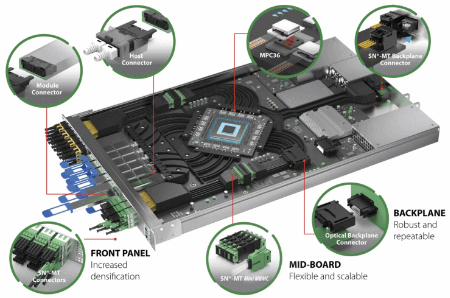
Two macro forces shape the industry:
4.8.1.Global AI Investment Cycle: The current explosive demand for 800G and 1.6T optical modules is a direct derivative of the largest AI infrastructure capital expenditure (Capex) cycle in history. Hyperscale cloud providers—Google, Microsoft, Amazon (AWS), Meta—alongside GPU leader NVIDIA, are deploying massive, purpose-built AI clusters to train and serve increasingly complex large language models (LLMs) and AI applications.
Demand Driver: These AI clusters, composed of thousands of interconnected GPUs (like NVIDIA’s H100/H200/B100) or TPUs, require an exponentially higher number of high-speed interconnects compared to traditional cloud data centers. The move from 400G to 800G and now toward 1.6T optical transceivers is not gradual; it is a step-function jump driven by the need to prevent data bottlenecks between accelerators.
Cyclicality vs. Sustainability: While this represents a demand super-cycle, the industry is keenly aware of historical hardware investment patterns. The critical question is the sustainability of this Capex wave. The answer lies in the monetization of AI services. As these investments translate into revenue-generating AI products, the Capex cycle is expected to be more sustained, though likely volatile in the short term. This drives the intense focus from module manufacturers like HYTOPTODEVICE on aligning production capacity with the roadmaps of key AI infrastructure players.
Implication for Suppliers: For optical transceiver companies, this means moving beyond being mere component vendors to becoming strategic technology partners. Success hinges on the ability to deliver high-volume, high-reliability 800G/1.6T modules that meet the stringent performance and schedule requirements of hyperscalers' next-generation AI cluster deployments.
4.8.2.Data Center Power Constraints:While AI drives demand, data center power and cooling limitations are becoming the dominant physical constraint dictating technology choices. The power draw of a single AI server rack can now exceed 50kW, and entire data centers are hitting utility power limits. Power Usage Effectiveness (PUE) is a paramount metric, and every watt saved on ancillary systems like interconnects can be redirected to computation.
The Optical Transceiver Power Problem: As data rates double, the power consumption of traditional plug-and-play optical modules (using DSPs for signal integrity) has become a significant burden. A 1.6T pluggable module using conventional technology could consume 20-25W or more, which is unsustainable at scale.
Technology Imperatives: This constraint is not merely an engineering challenge; it is a commercial imperative forcing a rapid architectural evolution:
Linear Drive Pluggable Optics (LPO): LPO eliminates the power-hungry DSP, offering a low-latency, lower-power solution for short-reach links within AI clusters (e.g., < 2km). It represents a crucial interim power-optimization strategy for 800G and 1.6T interconnects.
Co-Packaged Optics (CPO): CPO is the longer-term paradigm shift. By moving the optical engine directly onto the switch or accelerator package, CPO drastically reduces power loss and enables unprecedented port density and bandwidth. It is widely seen as the necessary path for 1.6T and 3.2T+ generations, especially for the highest-density AI fabric cores.
Silicon Photonics (SiPh): Both LPO and CPO implementations increasingly rely on silicon photonics technology. SiPh enables higher integration, smaller form factors, and ultimately, lower power-per-bit—making it a foundational technology for overcoming power constraints.
Supply Chain & Ecosystem Shift: This transition requires deeper collaboration across the ecosystem—from ASIC/GPU designers to packaging experts and optical component suppliers. It elevates the importance of co-design and advanced packaging.
The evolution from 800G to 1.6T is a race fueled by AI demand and enabled by breakthrough photonics. As a leader in high-speed optical solutions, HYTOPTODEVICE is committed to providing the verified, high-performance modules necessary for this transition.


