


使用HTML,JS,CSS制作页面模块,让你的网站变得更受欢迎

SR4 is built for short multimode runs inside a building. LR4 is built for 10KM single-mode runs between buildings or across a campus. Everything else follows from that.
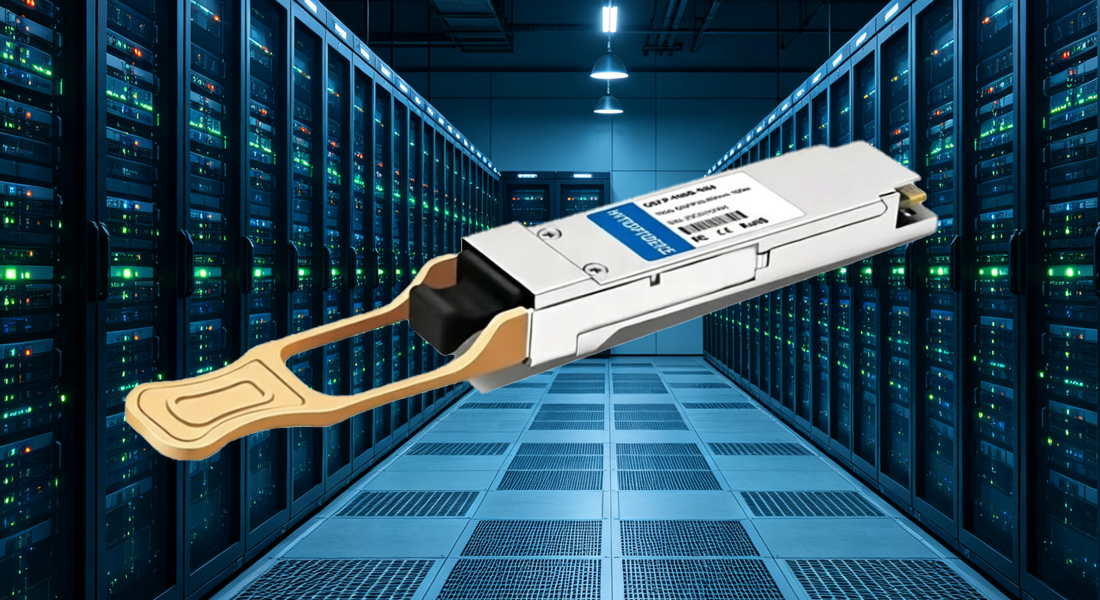
SR4 runs at 850nm across four parallel lanes, each at 25G, over OM3 or OM4 multimode fiber. The connector is MPO-12 (12-pin housing, 8 fibers active). Maximum reach is 70m on OM3, 100m on OM4.
Where SR4 makes sense:
SR4 is the lower-cost option per unit. The 850nm VCSEL arrays behind it are mature, high-volume components. If your distances stay under 100m and your fiber is multimode, SR4 is almost always the right call on economics alone.
One practical note: MPO-12 connectors require MPO patch cables and compatible MPO trunk infrastructure. If your existing plant is LC-based single-mode, SR4 forces a fiber infrastructure change — and that cost needs to go into your calculation before you commit.
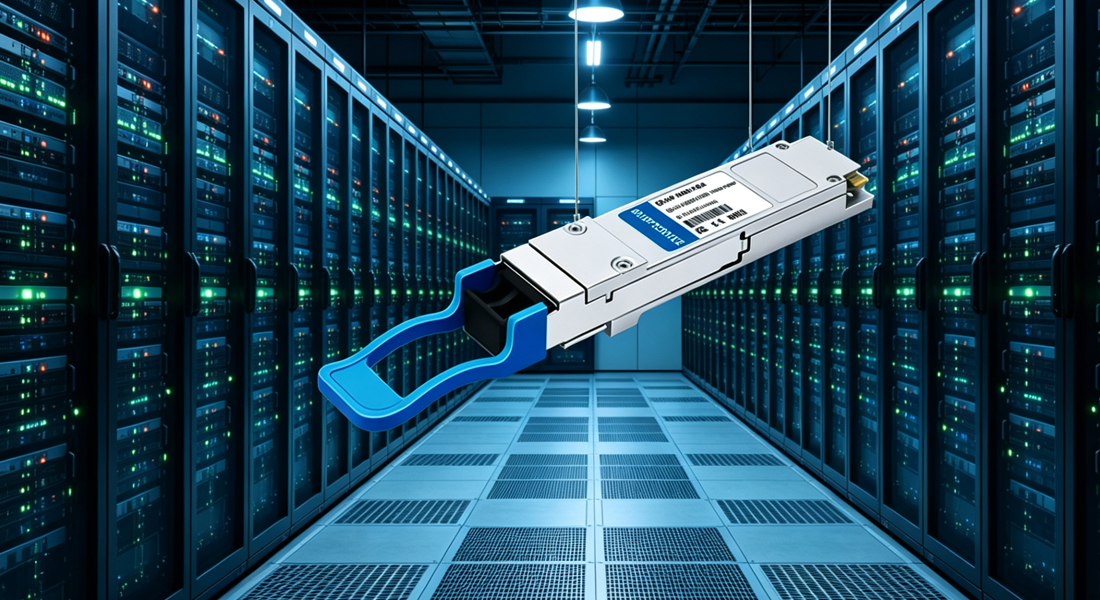
LR4 uses four wavelengths on the LAN-WDM grid (1295.56nm, 1300.05nm, 1304.58nm, 1309.14nm), each carrying 25G, multiplexed onto a single LC duplex single-mode fiber pair. Maximum reach is 10KM on G.652 SMF.
Where LR4 makes sense:
LR4 costs more per unit than SR4 — the LAN-WDM multiplexing and EML or DML transmitters are more complex to manufacture. But if your fiber plant is already single-mode, LR4 eliminates the external WDM mux/demux gear that CWDM4 sometimes requires and runs cleanly over a single LC duplex pair.
| Attribute | QSFP28 SR4 | QSFP28 LR4 |
|---|---|---|
| Speed | 100G (4x25G) | 100G (4x25G) |
| Wavelength | 850nm | LAN-WDM (1295–1309nm) |
| Fiber type | OM3/OM4 multimode | G.652 single-mode |
| Connector | MPO-12 | LC duplex |
| Max reach | 100m (OM4) | 10KM |
| Relative unit cost | Lower | Higher |
| Typical use case | Intra-DC fabric | DCI, campus, metro |
| Power consumption | ~1.5W typical | ~3.5W typical |
Unit price and total cost are not the same thing. The right comparison depends on your fiber plant.
Building a greenfield data center hall with OM4 structured cabling? SR4 wins on every line item: lower module cost, lower power draw per port, no single-mode fiber installation required.
Connecting two buildings 2KM apart on a campus where G.652 single-mode is already in the ground? LR4 is the cheaper total solution. Running new multimode fiber isn't an option at that distance for 100G, and adding active repeaters costs more than the module price difference. LR4 wins even at the higher per-unit cost.
The crossover point is roughly 300m to 500m. Below that, SR4 with multimode fiber is typically cheaper end to end. Above it, single-mode with LR4 becomes the more practical path once you account for everything beyond the module itself.
Compatible third-party QSFP28 modules — both SR4 and LR4 — deliver 70 to 90 percent cost savings versus OEM modules priced at 200 to 500 dollars or more per unit. That gap is meaningful at scale whether you're buying SR4 for a 200-port leaf-spine fabric or LR4 for a 48-port DCI deployment.
CWDM4 sits between SR4 and LR4 in certain deployments and is worth a brief mention.
It uses four CWDM wavelengths (1271nm, 1291nm, 1311nm, 1331nm) over LC duplex single-mode fiber with a maximum reach of 2KM. It costs less than LR4 and runs on the same LC duplex single-mode infrastructure. If your runs are under 2KM and you want single-mode without paying for 10KM optics, CWDM4 is a legitimate middle-ground option.
The tradeoff: CWDM4 requires external CWDM mux/demux if you're multiplexing wavelengths, and it's not interoperable with LR4 on the same link. For DCI runs in the 500m to 2KM range, CWDM4 competes directly with LR4 on cost. Beyond 2KM, LR4 is the only standard 100G QSFP28 single-mode option that reaches 10KM without amplification.
Both SR4 and LR4 are widely supported across all major switching platforms. Compatible modules tested against Cisco Nexus 9000 series, Arista 7000 series, Huawei CloudEngine, and Juniper QFX are available and well-documented.
The standard caution applies: verify MSA compliance and request compatibility test documentation before committing to a large order. HYTOPTODEVICE publishes compatibility test videos and datasheets on-site for exactly this reason. A 48-port deployment is not where you want to discover a firmware incompatibility after the modules arrive.
For Cisco-specific deployments, the QSFP-100G-LR4-S is the OEM reference part for LR4. Compatible alternatives that meet the same optical and electrical specs are available at a fraction of that price.
The decision tree is straightforward:
Don't let per-unit module price drive the decision without accounting for fiber infrastructure. The module is one line item. The fiber plant is a capital project.
HYTOPTODEVICE carries QSFP28 SR4, LR4, and CWDM4 variants across the full 100G QSFP28 catalog, with compatibility documentation available before you buy. If you're speccing a deployment or comparing options for a bulk order, start at hytoptodevice.com.
Q1:Can I connect a QSFP28 SR4 to a QSFP28 LR4 directly?
A:No. SR4 and LR4 use different wavelengths, different fiber types, and different connectors. They are not interoperable on the same link. Both ends must use the same transceiver type.
Q2:What fiber does QSFP28 LR4 require?
A:LR4 requires OS1 or OS2 single-mode fiber (G.652 standard) with LC duplex connectors. It will not operate over OM3 or OM4 multimode fiber.
Q3:Is QSFP28 SR4 compatible with 40G QSFP+ SR4 ports?
A:No. Both use MPO-12 connectors and 850nm wavelengths, but they run at different speeds and are not directly interoperable without a rate-matching or breakout configuration.
Q4:What is the power difference between SR4 and LR4?
A:SR4 typically draws around 1.5W. LR4 draws around 3.5W. In a high-density chassis with hundreds of ports, that difference adds up quickly in cooling and power budget planning.
Q5:Can QSFP28 LR4 reach beyond 10KM?
A:Standard LR4 is rated to 10KM on G.652 SMF. Extended-reach variants exist but fall outside the standard MSA spec. For runs beyond 10KM, DWDM or coherent optics are the appropriate solution.
Q6:How do I verify third-party QSFP28 compatibility with my switch?
A:Request the datasheet and compatibility test documentation from your supplier before ordering. HYTOPTODEVICE publishes test videos for major platforms including Cisco, Arista, Huawei, and Juniper. Testing against your specific platform firmware version before a large deployment is always the right approach.
Q7:Is CWDM4 interchangeable with LR4 on the same link?
A:No. CWDM4 and LR4 use different wavelength plans and are not interoperable. Both ends of a link must match — CWDM4-to-CWDM4 or LR4-to-LR4, never mixed.
